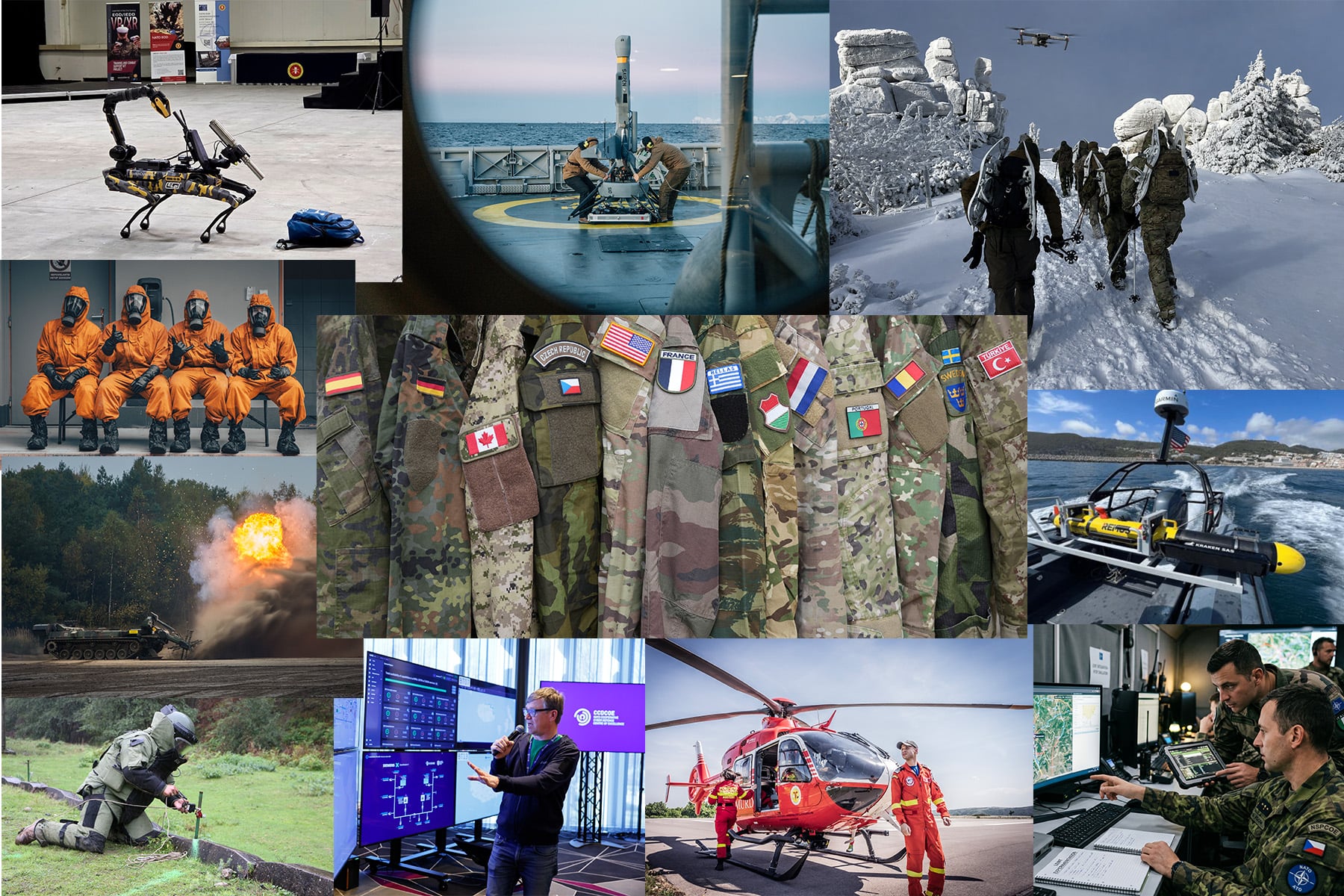
Each summer, Allied Command Transformation highlights the work of NATO-accredited Centres of Excellence. These nationally and multinationally funded institutions help the Alliance strengthen operational effectiveness by testing and validating concepts, improving interoperability, identifying lessons, and turning specialized expertise into practical support for NATO commands and nations.
This year’s COE Summer Series will take a new approach.
Rather than releasing a separate article for each participating Centre, the 2026 series will present theCentres of Excellence through six thematic groups. Each group brings together related areas of expertise and places them in the context of current transformation priorities and operational challenges facing the Alliance.
A Connected View of Transformation
The groupings reflect how modern military challenges are increasingly connected. Maritime operations depend on data, seabed awareness, littoral expertise, mine warfare, maritime security, and joint command relationships. Arctic readiness depends on cold-weather skills, mountain mobility, climate-security analysis, and sustainment in extreme environments.
The same pattern appears across every domain and function. Air and space operations depend on sensing, training, doctrine, autonomy, integrated defence, and multi-domain awareness. Resilience depends on civil-military cooperation, medical readiness, crisis response, modelling and simulation, and CBRN preparedness.
Across all six groups, the common theme is practical impact. The Centres are studying future challenges while testing tools, refining doctrine, improving interoperability, building shared understanding, and helping NATO move from expertise to operational effect.
Maritime Transformation
The maritime group will be framed in relation to NATO’s broader maritime transformation priorities, including the continued importance of experimentation, data-sharing, and operational integration at sea. It will include the Centres of Excellence for:
- Confined and Shallow Waters
- Maritime Security
- Maritime Geospatial, Meteorological and Oceanographic
- Naval Mine Warfare
Their work shows how NATO is improving its ability to understand and act in complex maritime environments. Examples include environmental data sharing through REPMUS and CWIX, data fusion for naval mine warfare, harbour protection, maritime security exercises, and joint maritime interoperability.
Together, these Centres help strengthen awareness and coordination from the seabed to the surface and across the wider maritime domain.
Arctic and Cold-Weather Readiness
The Arctic group will be presented in the context of growing Allied attention to High North readiness, including efforts such as TFX-Arctic and Joint Force Command Norfolk’s Arctic Sentry. It will bring together the Centres of Excellence for:
This group highlights the demands of operating where terrain, temperature, distance, infrastructure, and climate can shape every military option.
Initiatives like HEIMDALL in Norway, SkyEdge in mountain environments, and Arctic climate-security analysis all point to the same lesson: technology, people, and procedures must be tested against the conditions in which NATO may need to operate.
Land, Cyber, and Connected Infrastructure
The land and cyber group will be framed against NATO’s need for resilient infrastructure, protected networks, and greater interconnectivity across command and force structures. It will include the Centres of Excellence for:
- Counter-Improvised Explosive Devices
- Military Engineering
- Explosive Ordnance Disposal
- Cooperative Cyber Defence
These Centres are helping NATO think through protection in both physical and digital terms. Their work includes drone exploitation, virtual reality training for explosive ordnance disposal, vulnerability assessment software for force protection, and large-scale cyber exercises such as Locked Shields and Crossed Swords.
A drone, a bridge, an explosive threat, a software vulnerability, and a command network may sit in different technical communities, but in operations they can affect the same mission.
Air, Space, and Integrated Defence
The air group will be presented in the context of ACT’s wider focus on air and space integration, contested operations, and the future of Allied command and control. It will include the Centres of Excellence for:
This group focuses on training, sensing, doctrine, integrated defence, and multi-domain effects.
Current work includes online and simulation-enabled air operations training, passive 5G sensing for counter-UAS detection, counter-drone procedures, autonomous collaborative platforms, and the integration of space into NATO exercises, doctrine, and standards.
Intelligence, Policing, and the Information Environment
The intelligence and policing group will explore these functions as operational enablers. It will include the Centres of Excellence for:
- Counter-Intelligence
- Human Intelligence
- Security Force Assistance
- Stability Policing
- Military Police
- Strategic Communications
This group explores intelligence and policing as operational enablers. Together, these Centres support threat awareness, human intelligence training, law enforcement intelligence, battlefield evidence collection, advisor preparation, detention planning, and strategic communications experimentation in the information environment.
In conflict and crisis, these functions often overlap. Intelligence can shape protection measures, battlefield evidence can support accountability, policing can help stabilize contested environments, and strategic communications can help preserve trust. Presented together, they show how NATO’s understanding of the operating environment depends on more than military sensors and platforms.
Resilience, Enablement, and Multi-Domain Synchronization
The resilience and enablement group will be framed around NATO’s need to synchronize military activity with civil preparedness, crisis response, force health protection, and multi-domain planning. It will include the Centres of Excellence for:
- Civil-Military Cooperation
- Crisis Management and Disaster Response
- Joint Chemical, Biological, Radiological and Nuclear Defence
- Modelling and Simulation
- Military Medicine
Across this group, resilience is treated as a practical operational requirement: understanding civilian environments, rehearsing crisis response, preparing for CBRN threats, modelling complex operations, and protecting force health before and during deployment.
Examples include civil-military lessons from Ukraine, blackout response simulation, decontamination planning tools, multi-domain simulation projects, and near-real-time medical surveillance.
A Distributed Transformation Network
The 2026 COE Summer Series will present the Centres of Excellence as a distributed transformation network that connects national knowledge to NATO requirements and turns lessons, experiments, and concepts into usable capability.
By presenting the series through six connected groups, Allied Command Transformation will highlight not only what each Centre contributes, but how those contributions reinforce one another.
From maritime data fusion to Arctic experimentation, from cyber defence to counter-UAS sensing, from policing and intelligence to medical readiness, the Centres help NATO adapt in practical ways. Their work supports a more integrated, interoperable, and resilient Alliance prepared for the challenges ahead.