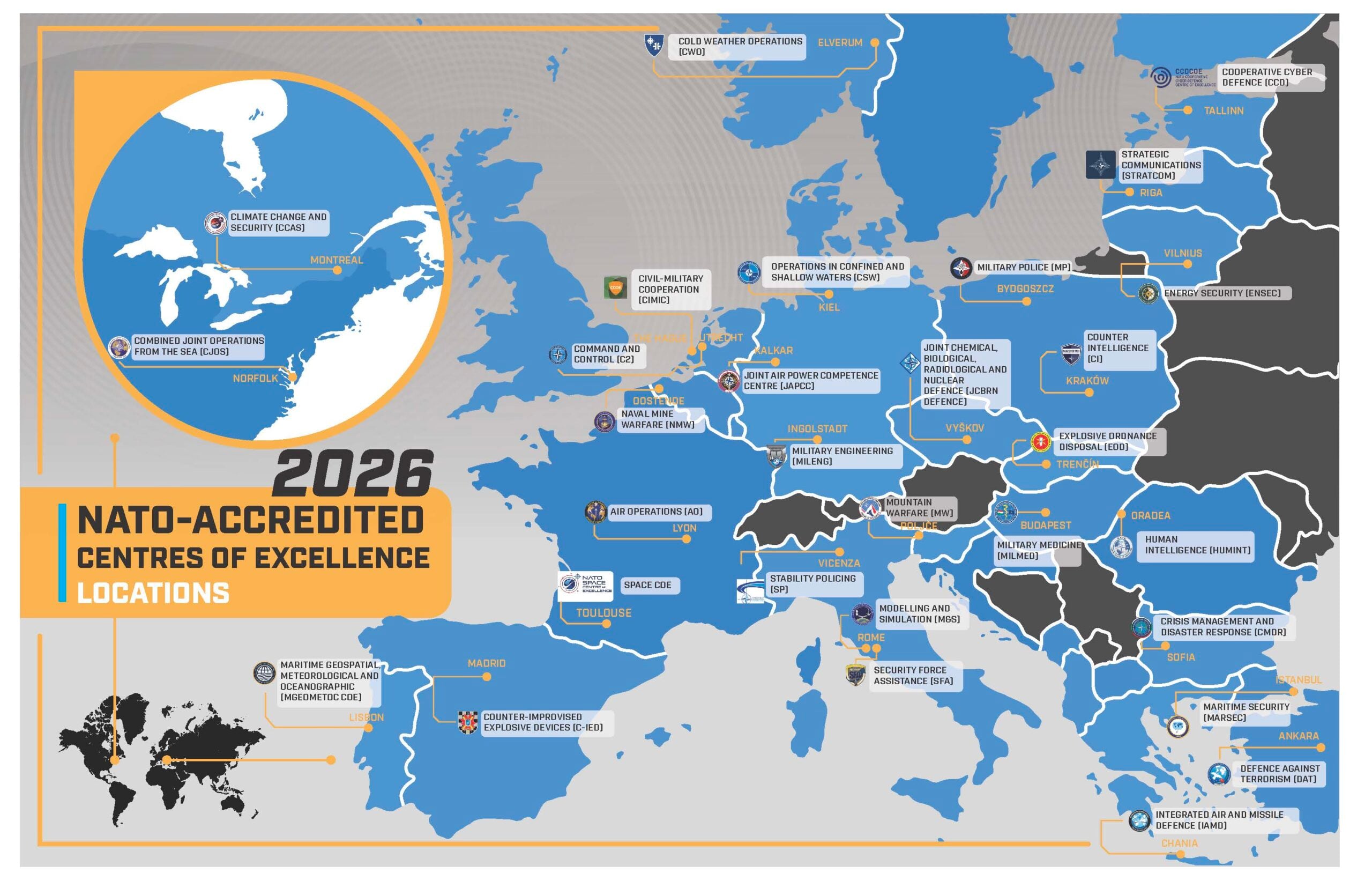
NATO’s Centres of Excellence (COEs) are one of the Alliance’s most practical ways of turning national expertise into shared Allied capability. Each Centre focuses on a defined field, such as cyber defence, military medicine, space, energy security, mountain warfare, strategic communications, or other specialized capability areas.
Centres of Excellence are nationally or multinationally funded institutions that provide recognized expertise in specific areas of military activity. They are accredited by NATO, but they are not part of NATO’s formal command structure.
That distinction matters because they provide the Alliance access to deep subject-matter expertise without creating new NATO commands or duplicating capabilities that already exist elsewhere in the Alliance.
The NATO – COE Connection
The Centre of Excellence model grew out of NATO’s broader transformation after the 2002 Prague Summit, when the Alliance began adapting its structures, concepts, and capabilities to meet a changing security environment.
As NATO’s missions became more complex, the Alliance needed flexible ways to study emerging problems, strengthen interoperability, support doctrine development, and improve training across nations.
Centres of Excellence help meet that need.
They allow NATO and Allied nations to turn specialized national expertise into shared Alliance benefit. Rather than every nation or command developing the same knowledge independently, COEs create focal points where expertise can be gathered, refined, tested, and shared.
How the COE Model Works
Each Centre is established around a specific area of expertise. A Framework Nation, or in some cases multiple Framework Nations, leads the development of the Centre and provides much of its infrastructure, personnel, and support.
Other Allies may join as Sponsoring Nations, contributing funding, staff, or expertise. Some Centres also benefit from Contributing Nations or partner involvement, depending on their mission and structure.
The result is a multinational model built on shared ownership.
NATO does not fund the Centres directly. Instead, nations invest in them because the work supports both national priorities and collective Alliance requirements.
Accreditation and Oversight
Before a Centre becomes NATO-accredited, it must go through a formal process led by Allied Command Transformation.
That process assesses whether the proposed Centre fills a genuine need, provides expertise that is useful to the Alliance, and avoids duplicating capabilities already available within NATO or another COE. The Centre must also show that it can act as a catalyst for NATO transformation and make its activities available to Allied nations.
Once accredited, Centres are periodically reassessed to ensure they continue to meet NATO’s standards.
This gives the COE network an important balance: the Centres remain nationally or multinationally owned, but their work is aligned with NATO priorities through accreditation, coordination, and review.
What Centres of Excellence Do
The work of the Centres varies by specialty, but most support NATO in several core ways.
They contribute to doctrine development and standardization. They conduct education, training, exercises, and evaluation. They capture and share lessons learned from operations, exercises, and emerging security challenges. They also support concept development and experimentation, helping NATO test ideas before they become formal requirements, doctrine, or capabilities.
In practical terms, a Centre can help NATO understand a problem, develop a common approach, train personnel, test new concepts, and share lessons across the Alliance. They are institutions that help connect knowledge to military practice.
The whole Alliance benefits from the expertise resident in the Centres of Excellence. They are flexible, multinational, and able to draw on knowledge that already exists across NATO. ACT’s role is to help connect that expertise to Alliance priorities, ensuring it supports transformation in a practical, coherent, and useful way.
– General Aurelio Colagrande
Deputy Supreme Allied Commander Transformation
How NATO Uses COE Support
NATO commands and entities can request support from Centres of Excellence through established coordination processes managed through Allied Command Transformation.
These requests help shape each Centre’s Programme of Work, alongside priorities from Sponsoring Nations and other stakeholders. This process helps ensure that COE expertise is connected to NATO’s real requirements and that the network is used effectively.
The model also allows Centres to work with a wider community. Depending on the subject, COEs may engage with military commands, national experts, academia, industry, partner organizations, and other institutions that can contribute to their field.
The Value of Independence
Because Centres of Excellence sit outside the NATO Command Structure, they have room to be flexible.
They can draw on national expertise, test ideas, host specialized training, contribute to doctrine, and explore emerging challenges in ways that complement NATO’s formal commands. At the same time, their NATO accreditation helps ensure their work remains relevant to the Alliance.
This independence is one of its greatest strengths.
It allows nations to lead in areas where they have particular expertise while making that expertise available to the broader Alliance.
A Network Built for Adaptation
Today, NATO’s 30 accredited Centres of Excellence form a diverse network of specialized knowledge across the Alliance.
Their areas of focus differ, but their purpose is shared: to help NATO learn, adapt, and improve. They connect national investment to collective benefit, strengthen interoperability, support transformation, and help the Alliance prepare for challenges that are already changing the way Allied forces think, train, and operate.
As NATO continues to adapt, the Centres of Excellence remain an important part of how the Alliance prepares for the future. They help NATO ask better questions, test new approaches, refine common standards, and turn specialized expertise into practical support for Allied forces.