
Innovation at Allied Command Transformation (ACT) is increasingly focused on delivery, fielding practical capabilities that fit into NATO operational networks and support real-world workflows. Three initiatives from ACT’s Innovation Branch production team demonstrate that shift from concept to delivery. Two of them (the NATO Maritime Availability Database, NMAD, and the Dynamic Integrated NATO Operational System for Air-to-Air Refuelling, DINO SAAR) are already in operational use by NATO and member nations. A third (Multi-Domain Exploitation and Data Unification from Sensor Arrays, MEDUSA) is now being developed as the next deliverable in short order.
NMAD: a delivered capability supporting 24/7 maritime operations
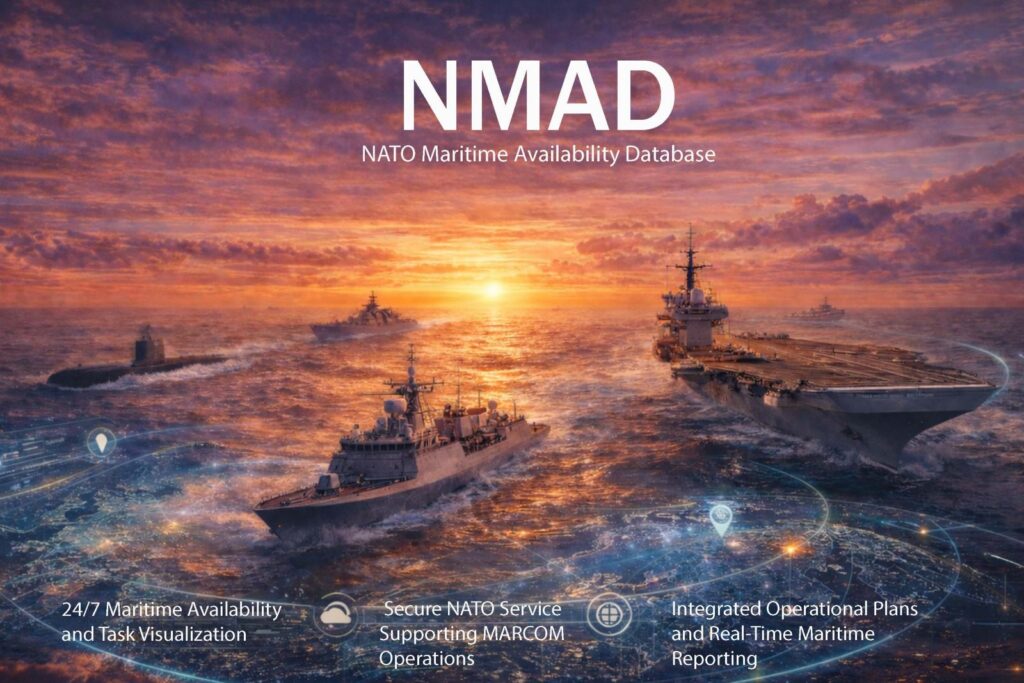
In the maritime domain, decisions depend on reliable awareness of unit availability, positioning, and assigned tasks. The NATO Maritime Availability Database (NMAD) allows users to visualize and report current and future unit positions and assigned tasks. It integrates operational plans with incoming reports and messages to improve situational awareness and coordination.
NMAD is now fully operational: a secure, cloud-based web application delivered to Allied Maritime Command (MARCOM) and accessible to MARCOM staff, maritime units, and NATO member nations. Delivered on a demanding timeline, the system required close cooperation with operational users and seamless integration with existing maritime platforms and command-and-control systems. In partnership with the NATO Communications and Information Agency (NCIA), NMAD was accredited and transitioned into a fully supported operational service aligned with NATO’s digital ecosystem.
The NMAD system is now actively supporting operational planning and execution within NATO, providing a solid foundation for maritime situational awareness and informed decision-making.
DINO SAAR: from exercise validation to operational use
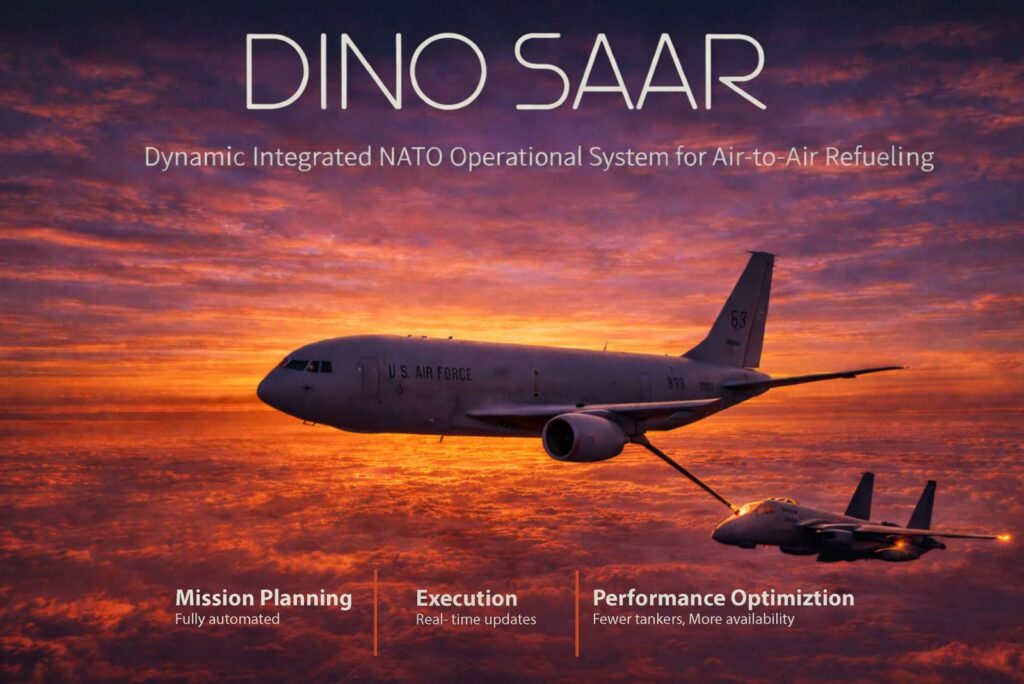
Air-to-air refuelling (AAR) is essential to generating airpower at scale but planning and execution can be time, and manpower, intensive, especially as conditions change. Dynamic Integrated NATO Operational System for Air-to-Air Refuelling (DINO SAAR) is a mission planning, execution, and training system designed to automate and optimize key parts of the AAR workflow. The system was successfully tested and operationally deployed during NATO exercises RAMSTEIN AMBITION 2025 and STEADFAST DUEL 2025, demonstrating fast automated mission generation and execution support with real-time updates while operating within a NATO operational network environment. It was built to meet NATO requirements and to integrate with existing NATO Air Command and Control systems.
ACT has previously covered the NATO-accredited Air Operations Centre of Excellence’s ALEXO initiative, which similarly focuses on automating air-to-air refuelling planning. While both ALEXO and DINO SAAR address related operational challenges, they are distinct and complementary efforts developed for different contexts, with DINO SAAR built and validated for NATO operational use.
DINO SAAR has progressed beyond a tech demonstration. It has been implemented and integrated within a NATO operational network environment and is currently in use by NATO and its member nations, with strong user appreciation reported following exercise validation. In practical terms, users reported that more efficient routing and reduced tanker requirements improved fuel efficiency and increased mission effectiveness.
Key highlights from the evaluation and operational use:
- Mission Planning — Fully automated, drastically reducing preparation time
- Execution — Automated with real-time data updates
- System Integration — Seamless interoperability with NATO Air Command, Control and Communications systems within NATO’s operational network
- Performance Benchmark — DINO SAAR generated solutions requiring fewer tankers for the same mission set, translating to significant fuel and resource savings and increased availability for additional missions and operations.
MEDUSA: the next capability in development
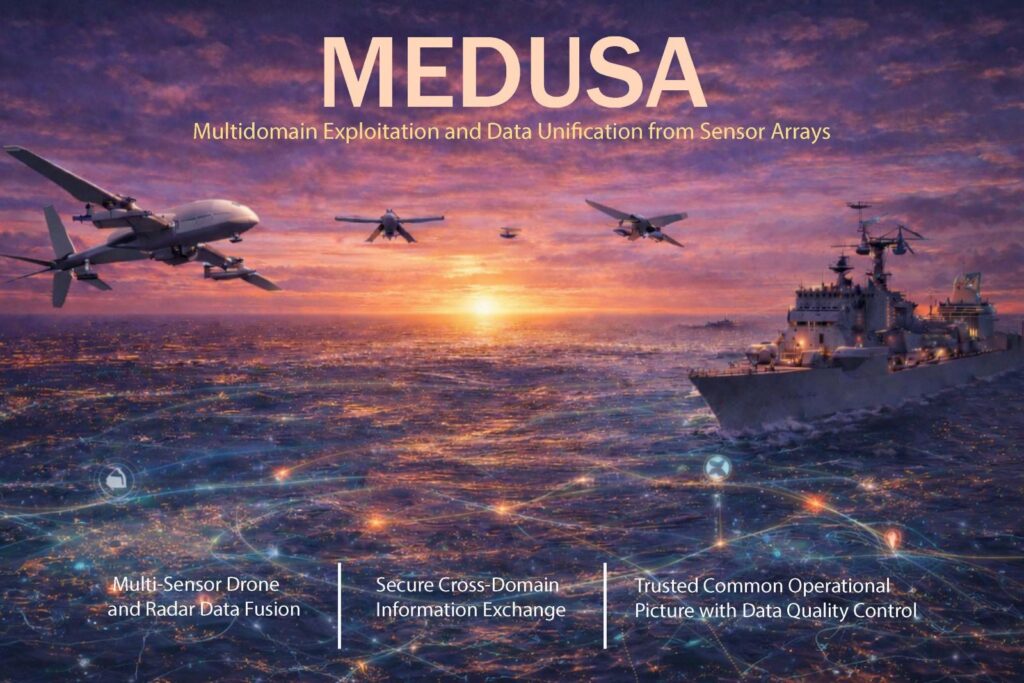
Multi-Domain Exploitation and Data Unification from Sensor Arrays (MEDUSA) is a new initiative to deliver a Multi-Sensor Fusion Engine for NATO Command and Control (C2) systems. The systems integrates data from multiple drones, sensors, and radars, supporting secure cross-domain information exchange, and identifies degraded or spoofed inputs. In practical terms, MEDUSA helps C2 personnel make faster and better-informed decisions by structuring complex data into an operationally relevant Common Operational Picture.
MEDUSA will provide coherent, reliable, and operationally useful multi-domain data fusion, ensuring a trustworthy operational picture through controlled integration of information and transparent management of data quality and confidence levels. This approach enables the combination of diverse data sources without generating ambiguity, inconsistency, or operational uncertainty.
Near-term validation is expected by the Summer of 2026 in a realistic operational scenario, with final validation planned during exercises in a live operational environment.
A delivery model for the Alliance
Together, these initiatives reinforce a straightforward point: ACT is shaping the future and delivering fielded capability that is already being adopted at the operational level across the Alliance. DINO SAAR and NMAD show what that looks like today, while MEDUSA points to where this work is going next. The common thread is not experimentation for its own sake, but delivery. By designing capabilities with users, integrating them into NATO systems, and transitioning them into operational use, ACT is shortening the path from identified need to usable capability across the Alliance.