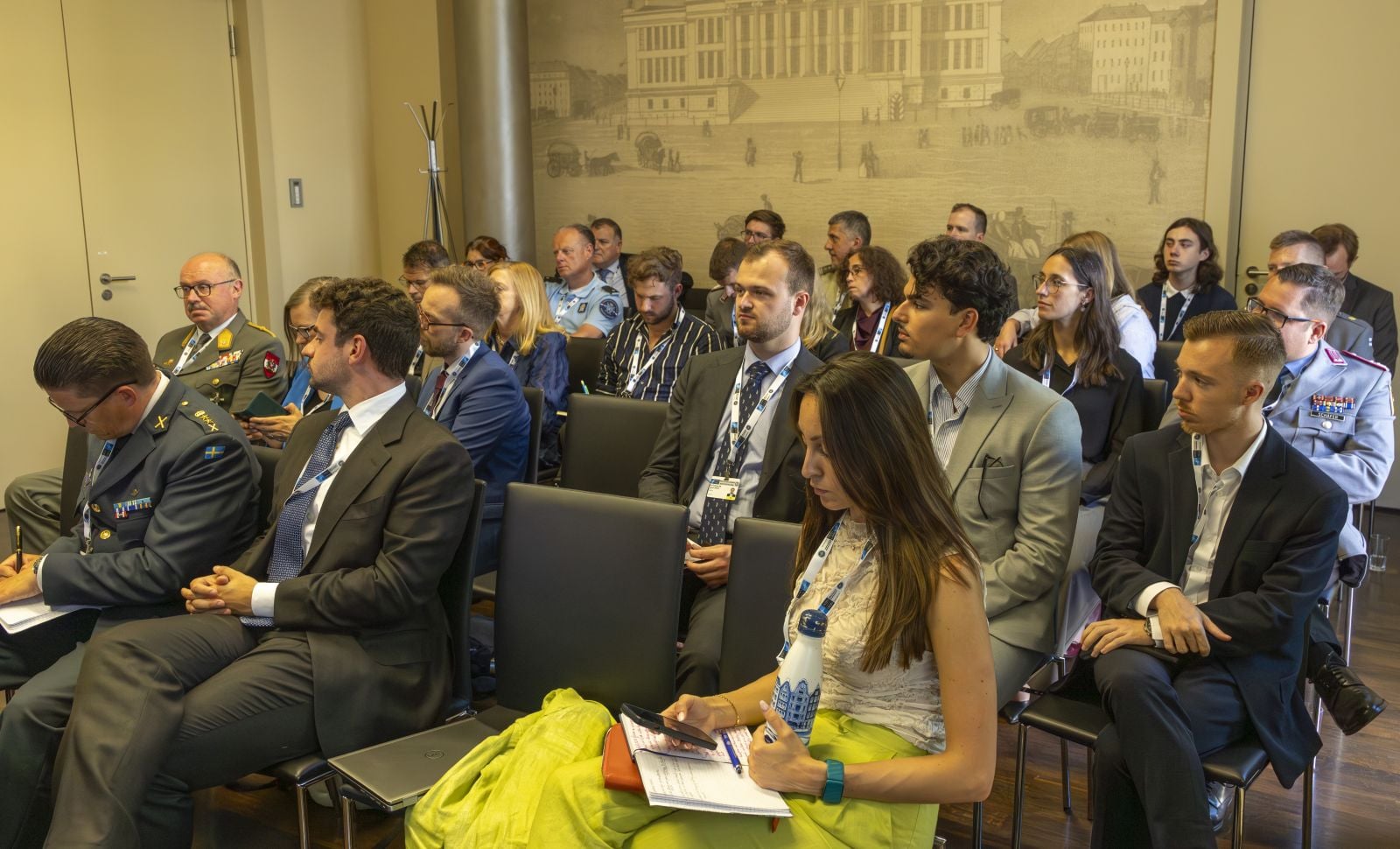
BERLIN, Germany. NATO Allied Command Transformation (ACT) recognized the winners of the NATO Student Challenge 2026 during the Allied Foresight Conference (AFC) in Berlin this week, highlighting the role of young leaders, innovators and future policymakers in shaping the Alliance’s approach to partnerships, technology and future security.
Rethinking Partnerships for a New Era
This year’s challenge invited undergraduate and postgraduate students from Allied and Partner nations to answer a forward-looking question: how should NATO redesign partnerships to maintain its technological edge, accelerate innovation and sustain Allied advantage across all domains?
The question reflected a changing security environment in which strategic competition, technological acceleration and hybrid threats are placing new demands on NATO’s partnership models. Existing tools were designed for a different era. Today, the Alliance must be able to connect more quickly with governments, industry, academia, startups, and other partners capable of contributing to future military advantage.
The response was significant. ACT received more than 150 submissions from students representing a range of countries, academic disciplines, and professional interests. Following an initial video submission phase, shortlisted participants were invited to develop their ideas into policy papers.
A panel of five ACT staff members evaluated the submissions based on creativity, originality, strategic relevance, clarity, and feasibility. From that process, three winning submissions were selected and invited to present their ideas to NATO senior leadership during AFC26.
Three Winning Ideas
The first winning submission, from Pol Gil Ortega of Spain, a Master of Business Administration student at ESADE Business & Law School, Ramon Llull University, focused on strengthening NATO’s technological edge through interoperability and defence innovation partnerships.
His proposal argued that interoperability must be treated not as an aspiration, but as a binding design requirement. He recommended linking NATO funding, exercise access and capability programmes to demonstrated interoperability compliance, while also creating multinational capability clusters and opening innovation pathways to non-traditional industry. The central idea was direct: NATO’s advantage depends not only on who innovates first, but on who integrates best.
The second winning submission, from Andy Dyachenko, Bruno Sol and Michaela Jonas of The Hague University of Applied Sciences, proposed the NATO Nexus Network, a framework designed to better connect Allied innovation ecosystems and accelerate technological adoption across the Alliance.
Their proposal called for secure data and collaboration infrastructure, multinational development hubs, joint testing environments, a shared digital backbone and stronger alignment of governance and standards. The concept aimed to preserve national autonomy while helping Allies develop, test and adopt emerging technologies with greater speed and coherence across land, sea, air, space and cyberspace.
The third winning submission, from Sayan Amjad and Thomas de Vaucleroy of Belgium, MBA Global Performance Management students at KU Leuven, proposed the O.P.E.N. Framework, or Open Partnerships for Ecosystems and Networks.
Their proposal called for NATO to move from a state-centric partnership model toward a dynamic innovation ecosystem that better connects governments, industry and universities. They recommended decentralized innovation hubs, trusted partner certification for private actors, operational innovation pathways, data trusts and agile governance mechanisms designed to help NATO capture emerging technologies where they develop and integrate them more quickly into operational use.
From Student Ideas to Alliance Advantage
Together, the winning proposals shared a common message: maintaining NATO’s technological edge will require more than invention. It will require faster integration, stronger interoperability, trusted data-sharing, closer links with the private sector, and more flexible partnership models.
That message aligned closely with the themes of the Allied Foresight Conference, which focused on strategic foresight, future operating challenges and the need to turn insight into action. The Student Challenge extended that discussion by asking the next generation to think directly about how NATO can build the partnerships it will need for the future.
During the recognition ceremony, Deputy Supreme Allied Commander Transformation General Aurelio Colagrande congratulated the winners and emphasized the value of their contributions.
The ideas we have just heard — your ideas — remind us that innovation does not only come from institutions; it comes from people who are willing to challenge assumptions and imagine new possibilities.
– General Aurelio Colagrande
Deputy Supreme Allied Commander Transformation
Investing in Future Thinkers
For ACT, the NATO Student Challenge reflected a broader commitment to preparing the Alliance for the future by engaging not only with new technologies, but with the people who will help shape how those technologies are used.
By bringing student ideas into a senior NATO forum, the challenge helped connect future leaders directly to NATO’s ongoing work on transformation, innovation, interoperability and multi-domain security. It also demonstrated that Allied advantage will depend on NATO’s ability to draw insight from a wider community and turn promising ideas into practical paths for action.
As the Alliance adapts to a more complex and contested security environment, initiatives such as the NATO Student Challenge help ensure that the next generation is not only observing NATO’s transformation but contributing to it.