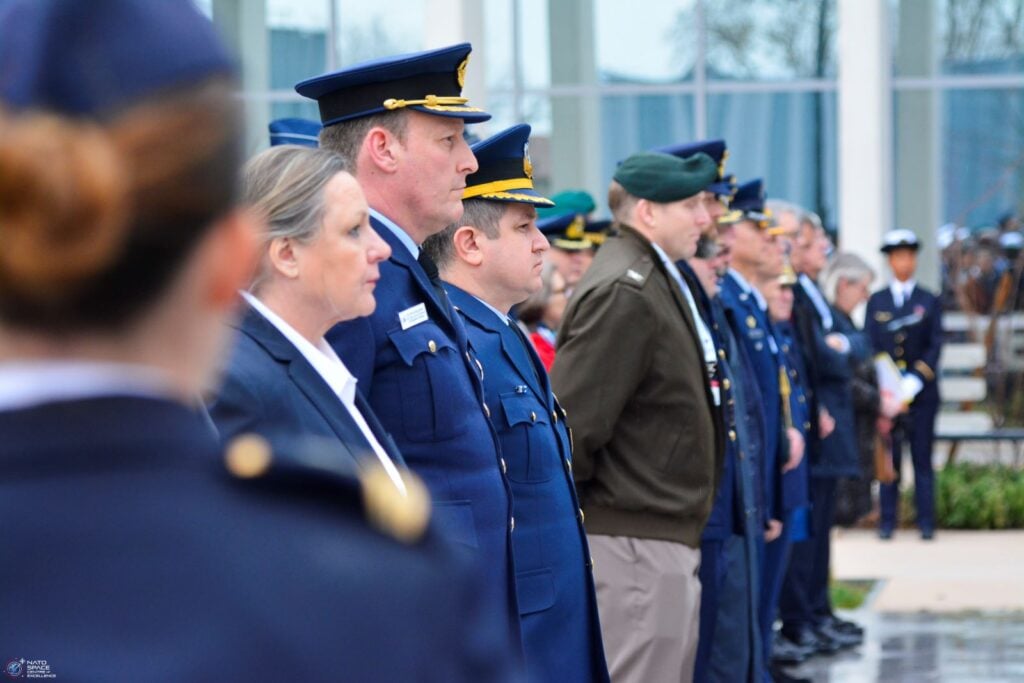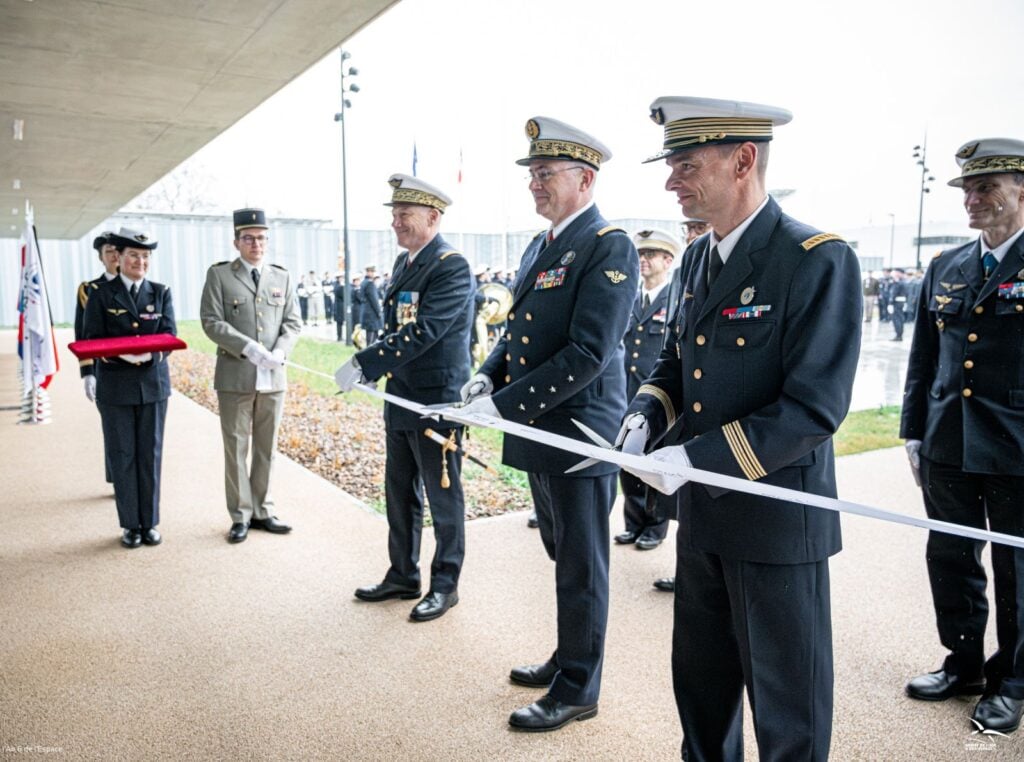

TOULOUSE, France. Earlier this week the NATO Space Centre of Excellence (Space COE) formally inaugurated its facility in Toulouse and announced it has reached Full Operational Capability (FOC), concluding a three-year ramp-up from institutional foundation to operational delivery. The ceremony was presided over by the Chief of the French Air and Space Force, General Jérôme Bellanger, and included remarks from Supreme Allied Commander Transformation, Admiral Pierre Vandier, and the NATO Space COE Director, Colonel Sylvain Debarre.
The milestone reinforces a practical priority for the Alliance: turning space expertise into usable outputs that improve how NATO trains, plans, exercises, and learns in a domain that has shifted from enabling support to strategic competition. In space, adversaries manoeuvre aggressively and develop increasingly sophisticated offensive tools. NATO’s response requires shared expertise that is actionable and interoperable, not fragmented across national stovepipes.
A domain that demands shared expertise
In his keynote address at the ceremony, Admiral Vandier set the context bluntly: “Space is now contested, crowded, and vital to everything we do.” He stressed that the scale and pace of change in the space domain make solo approaches insufficient, reinforcing the need for NATO to organize and share expertise in a way that is credible, practical and ready for operational use.
The Space COE’s rapid maturation reflects that demand signal. Its foundation was laid with the signing of a Memorandum of Understanding in January 2023, followed by NATO accreditation in July 2023. In April 2025, the Centre convened its first NATO Space COE Conference in Toulouse, bringing the community together around high-level thematic discussions on space issues. With this week’s inauguration and full operational capability announcement, the COE is now positioned to deliver consistently and at scale after a three-year ramp-up.
A growing multinational foundation
The Space COE is already drawing deep multinational participation. Fifteen nations are officially part of the effort: France, Belgium, Czech Republic, Germany, Greece, Italy, Luxembourg, the Netherlands, North Macedonia, Poland, Portugal, Romania, Spain, Türkiye, and the United Kingdom. The value of a Centre of Excellence is not simply its expertise, but its ability to translate multinational perspectives into shared standards, shared understanding, and shared readiness that NATO can apply in exercises, planning, and operational improvement cycles.
In addition, negotiations are ongoing to expand participation further, with the United States and Canada pursuing sponsorship and Australia pursuing contributing nation status as a partner nation. This continued growth reflects Allied recognition that the space domain demands collective focus and collective solutions.
What the Space COE delivers for NATO
The Space COE’s work is structured around the same four pillars that anchor the broader COE enterprise: concept development and experimentation, doctrine and standardization, education and training, and analysis and lessons learned. In practice, the Centre develops space operations concepts, strengthens staff readiness, supports major exercises, and feeds operational lessons back into NATO’s adaptation cycle.
Its location in Toulouse, at the heart of France’s space scientific, industrial, and military ecosystem, adds additional practical advantage. It places the Centre within reach of a dense network of national space expertise, while keeping its output focused on NATO requirements and multinational interoperability.
Looking ahead
The Space Centre of Excellence can now deliver consistently and at scale. One of its upcoming priorities is organizing the second edition of the NATO Space COE Conference, again bringing together key actors across the space community. For NATO, and for ACT’s role in coordinating the COE network, the measure of success will be continued production of concrete, high-impact outputs that can be adopted, reused, and integrated across Allied education, exercises, planning, and doctrine development.