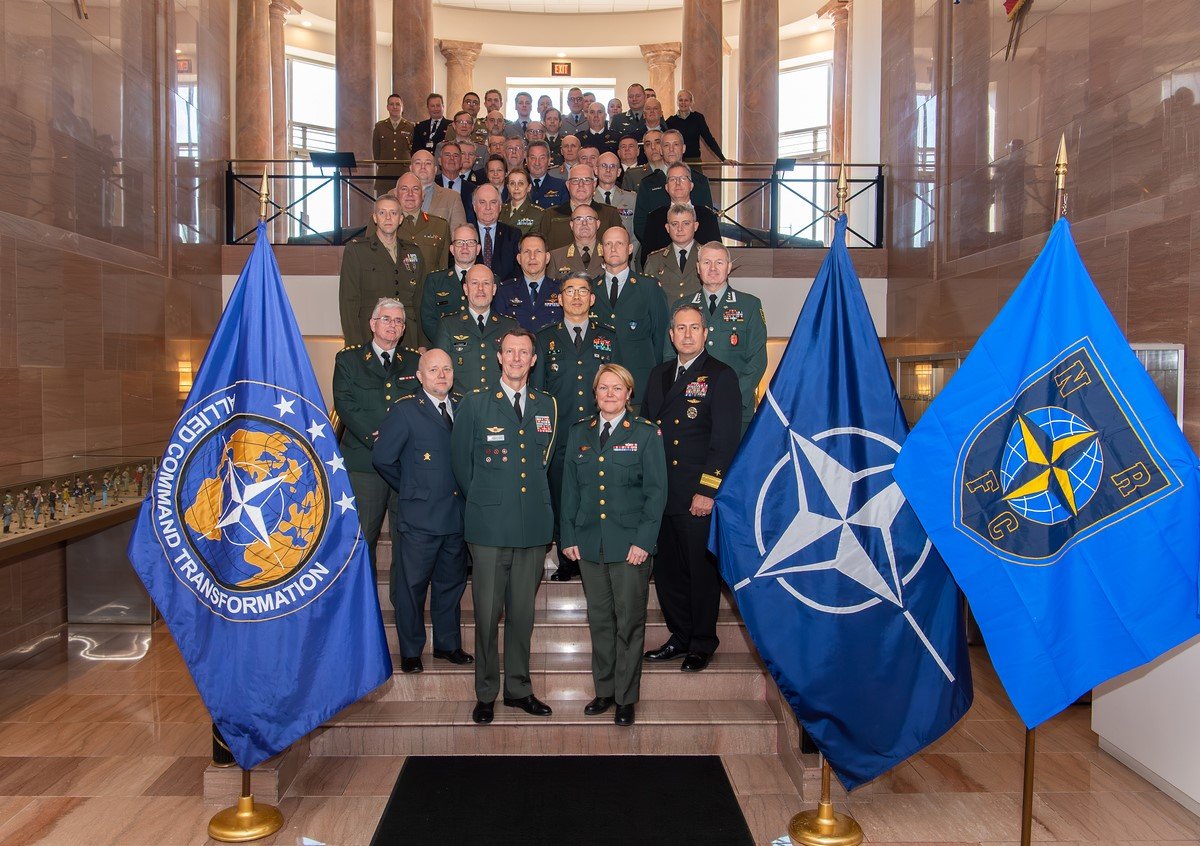
Washington, D.C. NATO Allied Command Transformation hosted the Annual National Reserve Forces Committee winter meeting in Washington, D.C. this week.
Over the course of three days of events, there were topical discussions, informative briefings, syndicate work, and tours of local landmarks in Washington, D.C. including the Pentagon and Arlington National Cemetery. Welcoming participants, the Chair of the National Reserve Forces Committee, Brigadier General Charlotte Wetche, Danish Army, stressed that the “Committee is an important forum for knowledge sharing between the member states and partner nations. Here ideas and implemented best practices on reserve matters are presented and discussed.”
The organization, composition, mission, and training levels of Reserve Forces vary widely across the Alliance. However, what the Reserve Forces of NATO Member Nations have in common is that they play an important role in the whole spectrum of national and NATO defence structures. In the event of crisis, they would be required to take up positions and carry out tasks alongside Regular Forces. Reserves are no longer considered to be the forces of the last resort; rather, they are now recognized as indispensable.
Another significant commonality most Reserve Forces throughout NATO share is the challenge to recruit and retain talent. “Approaches to this problem is one of the top issues in all meetings,” shared Brigadier General Wetche. “Further, the general change in the global security environment has sparked a renewed focus on reserve forces and how they can be governed. This utilization of the reserves is also a top issue for the National Reserve Forces Committee.”
Participants from 20 NATO member nations and 4 partner nations received a series of updates from a variety of NATO entities, including NATO School Oberammergau, the NATO International Military Staff and the Allied Command Transformation, as well as briefings from some NATO and Partner Nations. For some NATO Nations, reservists make up almost 50% of their National forces, which makes the exchange of ideas, procedures and lessons-learned even more valuable. In topical working sessions, members discussed NATO’s Reserve Policy with the goal of providing inputs to the International Military Staff as NATO is undergoing a revision of its policy which was last addressed in 2012.
The National Reserve Forces Committee serves as an essential platform for the leadership of NATO’s Reserve Forces to exchange best practices and delve into critical aspects of reserve management and deployment. Reporting directly to the Military Committee on Reserve policy, it plays a vital role in facilitating the gathering of diverse national approaches. The Committee aims to inspire and engage various stakeholders: whether it be inspiring citizens to become Reservists, helping civilian populations and employers grasp the significance of Reserve Forces, or helping nations establish and nurture their Reserve Forces.
In the past decade, the significance of reservists within national armed forces has significantly increased. They not only help bridge workforce gaps but also foster stronger connections between civil society and the armed forces. Additionally, they bring invaluable expertise in areas such as Information Technology, Cyber, logistics, Human Resources, Finance, and Medical, thereby enhancing the capabilities of the armed forces. Consequently, the role of the National Reserve Forces Committee has evolved in tandem with this growth.
The Committee continually adjusts its priorities, aligning them with NATO’s trajectory. Recent developments have particularly highlighted the importance of deploying Reservists in operational contexts, fostering employer support and engagement, nurturing future reserve cyber personnel, facilitating reserve involvement in exercises and training, and utilizing reserves across various military tasks.
This winter meeting of NATO’s National Reserve Forces Committee emphasized the importance of sharing best practices and adapting priorities to align with NATO’s evolving needs, particularly in areas such as Multi Domain Operations and Civil-Military engagement. With reservists comprising a significant portion of national forces in some NATO countries, the exchange of ideas and lessons learned becomes increasingly valuable, highlighting the crucial role of this Committee in fostering collaboration and innovation within the Alliance.