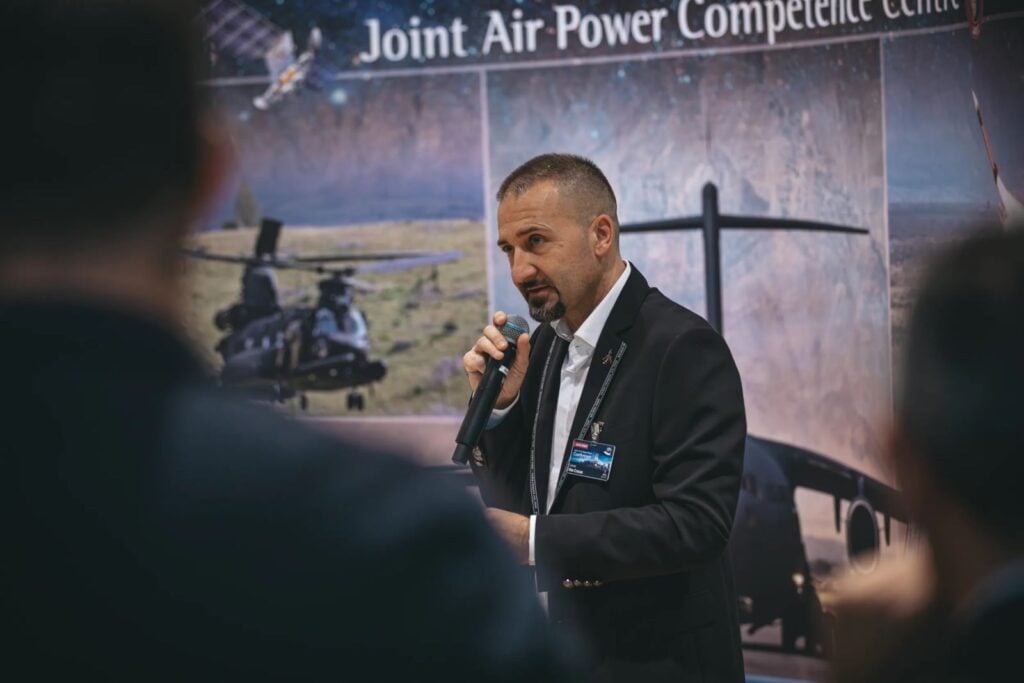

The Joint Air Power Competence Centre (JAPCC), NATO’s first accredited Centre of Excellence founded 20 years ago, is a multinational think tank based in Kalkar, Germany. The mission of JAPCC is to provide independent expertise to NATO, supporting the transformation of Joint Air and Space Power. The Centre is fulfilling its mission by connecting strategic foresight with operational realities, ensuring that NATO’s air and space forces remain effective, interoperable, and future-ready.
Operational Insight from the Battlefield
A key focus of JAPCC’s recent work has been the intensive analysis of Uncrewed Aerial Systems (UAS) used in current military conflicts. By collecting and evaluating operational data from the battlefield, JAPCC identified emerging trends, vulnerabilities, and tactical innovations in real time. These insights have been presented across numerous NATO forums and conferences, providing specific courses and directly informing Alliance discussions on counter-UAS strategies, air defence adaptation, and the integration of low-cost, high-impact technologies into NATO’s force structure.
Connecting Real-World Lessons to Policy and Planning
This operationally grounded approach is a hallmark of JAPCC’s methodology. Through initiatives like the Joint Air and Space Power Conference, JAPCC Think Tank Forum and the Joint Air and Space Power Network (JASPN), the Centre maintains close ties with servicemen, planners, and policymakers. These platforms allow the JAPCC to continuously gather lessons learned and project them into the development of future NATO Air and Space Power. Whether addressing air command and control, space integration, logistics, or cyber resilience, the community of experts ensures that NATO’s transformation is guided by continuous input from real-world experience, processed by professionals through cross-domain collaboration.
Harnessing Autonomous Platforms for Future Air Power
One example of this is their work on writing a Concept of Employment of Autonomous Collaborative Platforms. This effort supports NATO’s development of such platforms and emphasizes their role as AI-enabled force multipliers in future air operations. JAPCC advocates for NATO-wide operational analysis, interoperable design, and ethical frameworks to guide Autonomous Collaborative Platform integration. The work highlights these platforms’ potential in Intelligence, Surveillance and Reconnaissance, electronic warfare, air defence and strike missions, while also addressing vulnerabilities such as cyber threats.
Advancing Allied Interoperability in the Air
They have also been actively advancing the work on the Air-to-Air Refuelling (AAR) Clearance & Compatibility Matrix to enhance interoperability and standardization across the Allied and Partner Nations. This effort is driven by the need to ensure seamless multinational air operations and maximize the effectiveness of limited aerial refuelling resources. The desired outcome is an interoperable AAR fleet within NATO, supporting strategic reach and operational flexibility between diverse tanker and receiver platforms. This work matters because NATO’s air and space superiority is no longer unchallenged. JAPCC’s ability to translate operational insights into strategic guidance helps NATO stay ahead.
Fostering Multi-Domain Innovation Through Exercises and Publications
The JAPCC Command, Control, Communication, Computers, Cyber, Intelligence, Surveillance, Reconnaissance and Space Branch is spearheading efforts to integrate cyber and space capabilities into air exercises through the development of a dedicated exercise playbook. This resource offers a structured framework with planning considerations, sample injects, and best practices to enhance realism and interoperability in training. In parallel, the Centre’s recent publications (such as white papers on resilient satellite communications and missile defence readiness) demonstrate a strong commitment to advancing operational concepts through actionable analysis. Together, these initiatives support NATO’s evolution toward effective Multi-Domain Operations by bridging practical training with forward-leaning research.
Looking Forward: Shaping the Next 20 Years
The JAPCC will continue to serve as a bridge between today’s operational environment and tomorrow’s strategic needs. By fostering a culture of collaboration, experimentation, and critical thinking, the Centre helps ensure that NATO’s air and space forces are not only ready for what’s next, but are actively shaping it.
Learn more at https://www.japcc.org/.