Whether countering drones, monitoring the Arctic, building resilience against cognitive warfare, or neutralizing glide bombs, the NATO Innovation Challenge has consistently taken on some of the most pressing security problems of our time. It has become a proving ground for ideas with the power to shape the future of security.
Several times each year, Allied Command Transformation works with a NATO nation to host the event. This opens the door to innovators far beyond NATO’s traditional networks, where students, start-ups, researchers, and entrepreneurs are invited to tackle real-world challenges.
What began as an experiment to connect fresh thinking with complex defence needs has become a multinational forum for collaboration and creativity. The NATO Innovation Challenge now delivers technological advances, builds new partnerships, and speeds the adoption of solutions that NATO can move from concept to practice in months instead of years.
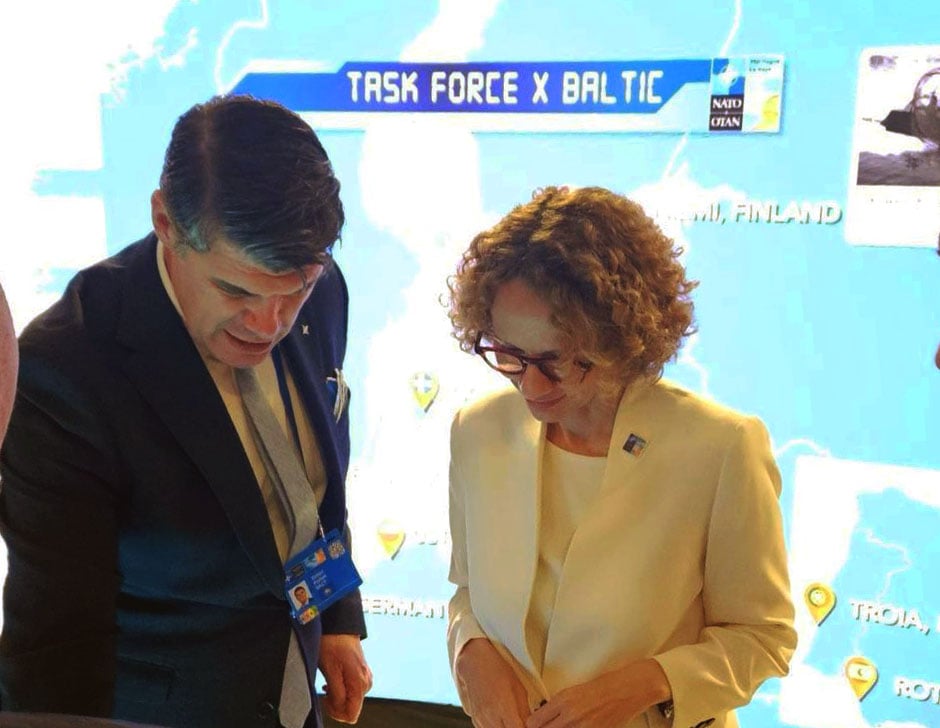
Simon Purton, Branch Head for Innovation at NATO Allied Command Transformation, has witnessed the evolution of this initiative first-hand. Earlier this year, he attended the NATO Summit in The Hague to demonstrate Task Force X, one of the Innovation team’s rapidly adopted technologies. During the event, a reporter jokingly asked whether his position made him the “Tony Stark of NATO.” While the comparison to the tech genius alter ego of Marvel’s Iron Man was light-hearted, it underscored something true about Simon’s own role: he drives NATO’s ability to harness bold ideas and translate them into operational capability, at speed.
With that perspective, we sat down with Simon to talk about the origins of the Innovation Challenge, its role today, and the future he envisions for it.
Q: How would you describe the NATO Innovation Challenge to someone hearing about it for the first time?
Simon: Have you ever seen a Batman movie? A NATO Innovation Challenge is the equivalent of Commissioner Gordon switching on the Bat-Signal. It’s a sign that NATO wants something important, quickly. We have mechanisms to reach out to a broad range of potential solution providers who we can depend on to provide something that could be of significant value to an operational problem. Once the Bat-Signal is switched on, things happen very fast. We solicit a broad range of solutions before quickly filtering down to just a few of the most promising ones for rapid follow-up and potential adoption.
Q: Why is it important for NATO to connect with innovators outside of the traditional defence industry?
Simon: “Not wanting to necessarily disagree with your question but let me offer that it is really important that NATO connects with a broad range of innovators, inside and outside of the traditional defence community. Our Innovation Challenges are open to all. What we find is that often Innovation Challenges raise issues, or touch on problems, that haven’t already been addressed by traditional industry. However, our last few challenges have included proposals from what I think most people would consider traditional defence industry.”
Q: How do you decide which problems or themes will be the focus of each edition?
Simon: “We have a number of models for identifying themes or problems. For a time, we focused on delivering a certain number of challenges each year and then soliciting possible topics from across NATO – so you could think of that as a level of ambition approach. More recently, we have shifted this towards a model of supporting other ongoing efforts. So rather than deliver a specific number each year, the frequency of challenges is now more directly related to the projects we are supporting. For the last year, we have been driven by our support to Ukraine via the Joint, Analysis, Training, and Education Centre, such as countering glide bombs and fibre optic drones.”
Q: What makes the Innovation Challenge different from other global innovation competitions?
Simon: “I don’t think our Innovation Challenges are fundamentally different from many other innovation challenges. Organizations use mechanisms like innovation challenges to take a broad and very unconstrained look at all solutions. Where I like to think that we are a little different is how quickly we try to operationalize winning proposals. NATO is able to very rapidly bring these solutions into ongoing exercises and events. Proposals from our most recent Innovation Challenges have been involved in “live fire” exercises as well as integration our Innovation Continuum within months.”
Q: The most recent Innovation Challenges addressed real and urgent needs Ukrainians have been experiencing on the battlefield. How did you balance speed with ensuring the right problems were put forward?
Simon: “We have a range of tools and mechanisms available to address operational challenges. I think Innovation Challenges are where we do things quickly… speed is an important part of the response. So I think it is implicit in an Innovation Challenge that “speed” is more important than being “perfect”. It’s a deliberately accepted compromise. In other mechanisms, like Task Force X, we take a little more time to deliver a different effect.”
Q: How do you see the Challenge evolving in the next five to ten years? Do you have goals for reshaping the Challenge?
Simon: “Presently, we “invoke” an innovation challenge… so like Commissioner Gordon, we have to deliberately “switch on” the signal. I would love to get us to a position where, in addition to deliberately creating innovation challenges, we were able to more persistently connect providers with problem owners through our Innovation Network. That way these connections wouldn’t only happen when the “signal” was on. The U.S. Special Forces community has an innovation mechanism called Vulcan that very much delivers this type of effect – perhaps we can call ours “Romulus” in homage to Star Trek!”
Q: What do you think the Innovation Challenge says about NATO’s broader approach to innovation?
Simon: “I think it speaks to NATO’s desire to leave no stone unturned when it comes to operationalizing the various advantages the Alliance has. Our democracies support and encourage creative and entrepreneurial thinking. This is a strength we have in the Alliance. Conversely, due to the systems of government and operational models that our competitors employ, they simply cannot generate the diversity of thought and participation that makes the Alliance so resilient.”
Through Simon Purton’s lens, the NATO Innovation Challenge emerges as more than just a competition, it is a deliberate signal to the global innovation community that NATO is ready to listen, experiment, and act quickly. By casting a wide net that welcomes both traditional defence players and unconventional newcomers, the Challenge ensures no potential solution is overlooked. Its strength lies not only in the creativity it attracts, but also in NATO’s ability to rapidly test, adopt, and operationalize those ideas.
With a vision to make innovation less episodic and more persistent, Innovation Networks can connect problem owners, and solution providers, long after the “signal” fades. At its heart, the Challenge underscores a broader truth: NATO’s greatest advantage is the ingenuity of its people and partners, and the willingness to transform bold ideas into real-world impact.