NATO is in an adaptation race. The pace of geopolitical change is fast, and the pace of technological change is faster. Audacious Training is designed for that reality, anchored in a simple operating logic: if NATO waits for perfection before acting, it will be too late. The initiative embraces calculated risk, knowing that 80% on time delivers more value than 100% too late.
Audacious Training is delivered through an agreed partnership between NATO’s two Strategic Commands (a “Bi-SC” arrangement): Allied Command Transformation (ACT) and Allied Command Operations (ACO). It is grounded in NATO’s endorsed Collective Training and Exercises framework and advanced through close coordination between the two commands.
The aim is straightforward: ensure NATO forces are trained to deter in competition, operate effectively in crisis, and win in conflict. It strengthens readiness for the “fight tonight” while building foundations for the “fight tomorrow”. It does this by shifting training from something that can become overly scripted and predictable into something more realistic, more adaptive, and more tightly connected to learning and warfare development.
The shift: from predictable training to adaptability as a capability
Audacious Training starts from a blunt assessment: training cannot be static and predictable. Modern conflict and competition do not hold still. The “race” keeps changing shape, and NATO has to be ready for that. The initiative treats adaptation as a behaviour that must be trained deliberately, because adaptability itself is becoming a strategic capability across the Alliance.
In practical terms, that translates into training environments that better reflect real world scenarios, including real geography, real complexity, and real adversary behaviour. It includes safe to fail environments where commanders can push headquarters to the point of friction, expose vulnerabilities early, and learn quickly. It also expands free play, including sustained 24/7 operations, so training audiences face unpredictable situations rather than rehearsed sequences.
One tangible example is how NATO is strengthening opposing forces actions in exercises to make training less predictable and more operationally relevant. These “enemy” teams are built to think and act like a capable opponent: they probe plans, exploit seams, introduce realistic deception and disruption, and force headquarters to adapt in real time instead of following a scripted path. That includes deeper expertise on adversary behaviours associated with Russia, China, and others, supported by a dedicated capability that stress tests assumptions and injects real friction into scenarios. It also draws on operational insight from Ukrainian partners through the NATO-Ukraine Joint Analysis, Training, and Education Centre (JATEC), helping ensure scenarios reflect current realities and drive learning that translates into better preparedness.
How Audacious Training works in practice
Audacious Training is built around three practical pillars. Together, they help NATO make training more realistic, learn faster from what happens, and keep pace with how security challenges and technology are changing.
- Support Enhanced Readiness – Making training more realistic and more useful
The first pillar, “Support Enhanced Readiness,” is about making NATO’s major training activities feel closer to the conditions forces would actually face. That means less predictability, more complexity, and more emphasis on how units and headquarters perform under pressure. It also means being smarter about how readiness is assessed, so training results highlight what matters operationally, not just whether a checklist was completed.
- Embrace New Technologies and Innovation – Modernizing the tools that enable training
The second pillar, “Embrace New Technologies and Innovation,” focuses on modernizing how training is designed and delivered. This includes digital and data driven approaches that help designers build scenarios faster, run training events with more flexibility, and capture results more clearly. The point is not to add technology for its own sake. The point is to make training more responsive and help forces adapt when conditions change.
- Set and Build Readiness for Tomorrow – Turning lessons into improvements faster
The third pillar, “Set and Build Readiness for Tomorrow,” is about shortening the time between identifying a lesson and making a real improvement. Training strengthens deterrence when it drives real improvements, and those improvements must arrive fast. Audacious Training puts emphasis on capturing what worked and what did not, avoiding the trap of relearning the same lessons, and feeding those insights into how NATO trains and prepares next time.
A useful way to picture this is a high-performance pit crew model. The point is not just to run the race and record lap times. It is to diagnose what is slowing you down, fix it immediately, and feed those improvements into the next lap before conditions change again. That is the logic behind the dynamic lessons loop, which explicitly flags today’s lessons learned process as too slow, too fragmented, and in some areas effectively broken.
Beacon Project: AI in Audacious Training
Beacon Projects are ACT’s priority initiatives selected to move proven ideas into NATO use quickly. Chosen through NATO ACT’s Adoption Board and under active senior leader stewardship, they focus on practical, near-term impact rather than long-range experimentation.
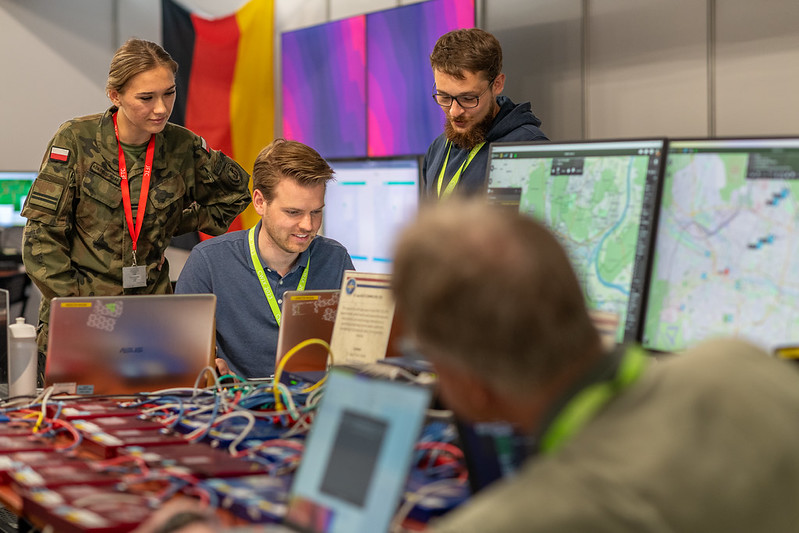
The “AI in Audacious Training” Beacon Project applies artificial intelligence to the behind-the-scenes work that makes major exercises possible. This Project is a part of the second pillar (“Embrace New Technologies and Innovation”) of the wider Audacious Training initiative.
A key focus is automating parts of scenario design that traditionally take a lot of manual effort, especially writing the event and incident injects that drive an exercise storyline and force decision making. Done well, this does two things: it speeds up how quickly an exercise can be built and refined, and it helps training feel less predictable because planners can generate more varied, dynamic, and realistic situations without adding weeks of workload. The goal is not to replace human judgement. It is to reduce the administrative burden so experts can spend more time on realism, learning objectives, and operational relevance.
This work is being executed by NATO’s Joint Warfare Centre, with overall direction and coherence provided by Headquarters, Supreme Allied Commander Transformation, and coordinated in a way that supports the shared ACT and ACO approach to Audacious Training.
The approach is deliberately incremental: deliver something useful early, learn from it, and improve it step by step. That mindset prioritizes practical capability now over waiting for a perfect end state, while keeping the system flexible enough to grow as NATO’s broader training and simulation capabilities evolve.
What comes next
Audacious Training is moving from concept to implementation through clear near-term milestones and agreed coordination between the two Strategic Commands. For the AI enabled training work, the near-term plan is to demonstrate an initial pilot at the NATO Summit 2026 and continue testing during major NATO exercises in 2026, including STEADFAST DUEL 2026 and STEADFAST DAGGER 2026.
Progress will be judged in practical terms: whether training can be designed faster, whether scenarios become more realistic and less predictable, and whether lessons are captured and translated into improvements without delay.
Why this matters
Audacious Training is ultimately about one outcome: helping NATO adapt faster in an environment that rewards speed, realism, and learning under pressure.
Evaluation remains essential, but it is not the only goal. The broader aim is to build a training system that does not just measure readiness, but actively improves it through experimentation, learning, and rapid refinement.
NATO’s advantage depends on more than capabilities on paper. It depends on how quickly forces can learn, integrate, and adjust together. Audacious Training is one way the Alliance is ensuring its training keeps pace with the world it is preparing for.