This week in Brussels, Allied Command Transformation convened Chiefs of Defence (CHODs) and senior NATO leaders to examine how Ukraine’s warfighting experience is reinforcing and accelerating the Alliance’s approach to deterrence, defence, and future conflict.
The high-level meeting brought together nearly 100 representatives from all 32 Allied nations, NATO’s International Military Staff, NATO’s International Staff, Allied Command Transformation, Supreme Headquarters Allied Powers Europe, and Ukraine.
Opening the discussions, Supreme Allied Commander Transformation (SACT), Admiral Pierre Vandier, underscored the scale and significance of Ukraine’s experience, noting that Ukraine has now endured 1,429 days of war.
“Constantly under attack, the Ukrainian people and armed forces have demonstrated an impressive resilience and adaptability,” Admiral Vandier said, highlighting how this experience has become central to NATO’s understanding of modern warfare and its ongoing adaptation.
A Warfighting Experience That Strengthens NATO Readiness
Admiral Vandier described the war in Ukraine as a real-world proving ground because it has provided direct operational insight into how capabilities perform under sustained combat conditions.
“A lot of our capacities have been sent there, giving us direct insight into their efficiency and resilience,” he noted, emphasizing that this exposure is actively informing NATO’s modernization, readiness, and capability development efforts across the Alliance.
Speaking during the discussions, Colonel Valerii Vyshnivskyi, Senior Ukrainian Representative at the Joint Analysis, Training and Education Centre (JATEC), highlighted that Ukraine’s warfighting experience has been shaped by necessity as much as design.
“We did not have the luxury of separating innovation from operations,” Colonel Vyshnivskyi said. “We had to adapt while fighting, integrating new systems, adjusting command and control, and learning faster than the adversary. Every day was about survival.”
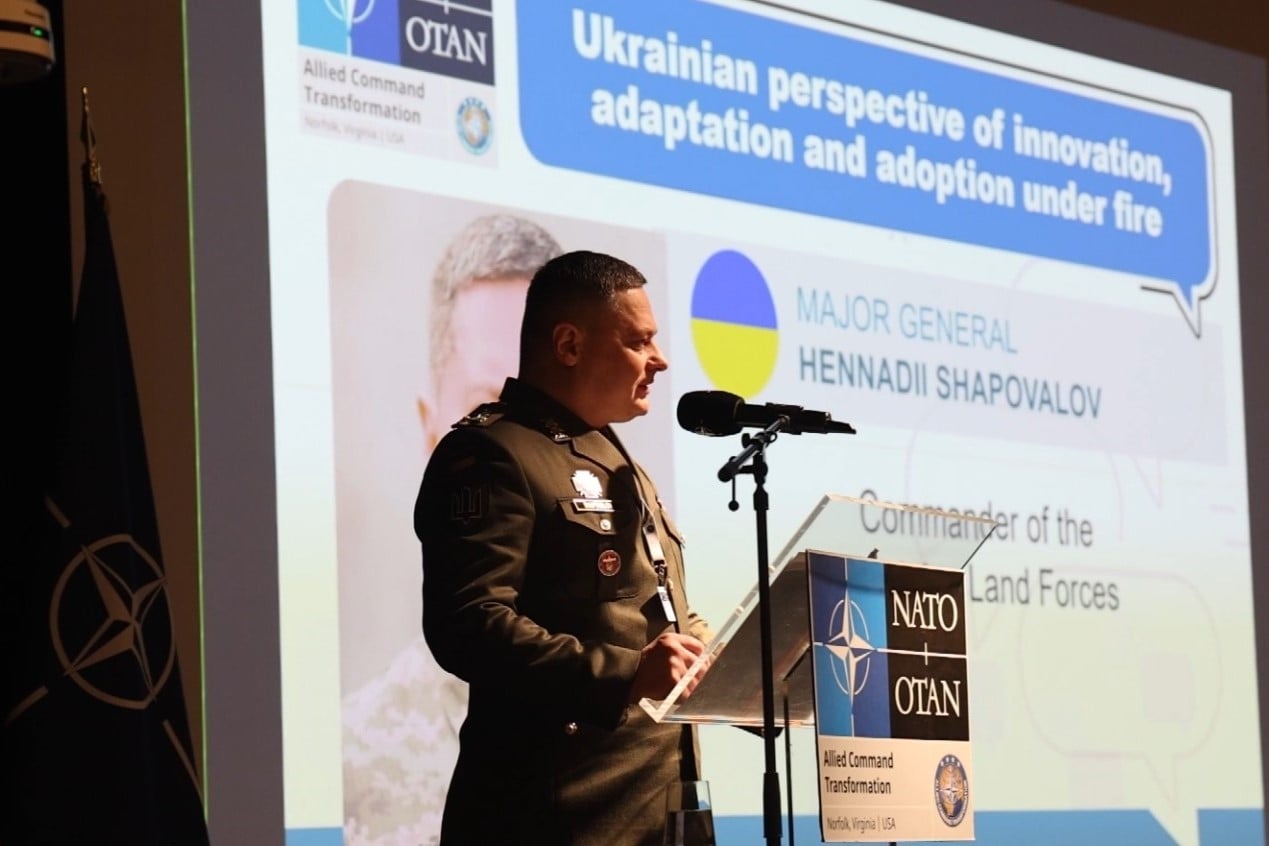
Major General Hennadii Shapovalov, Commander of Ukrainian Land Forces, joined NATO military leaders in Brussels and emphasized that modern warfare is defined by more than material resources.
“Modern war is not only about resources. It is about speed of decision-making and the implementation of change,” he said, warning that battlefield effectiveness is achieved “not through superiority in a single domain, but through synergy and networked integration across all components.”
He noted that this synergy of capabilities has become a decisive factor in modern warfare.
This theme was further developed in a briefing by Andrii Hrytseniuk, Head of Brave1 at Ukraine’s Ministry of Digital Transformation, who presented operationally proven digital tools used in the conflict zone. These included an online marketplace accelerating access to weapons and equipment, as well as digital targeting and prosecution tools enabling faster decision-making and effects delivery.
Technology, Adaptation, and Interoperability at Scale
Jack Watling, Senior Research Fellow for Land Warfare at the Royal United Services Institute, who splits his time between the United Kingdom and Ukraine, provided strategic perspective during his remarks on understanding how Russia may prepare for future conflict with NATO.
“The Russians are deterred by the unity of NATO,” Dr Watling said, underscoring the Alliance’s collective strength and cohesion as a central pillar of deterrence. At the same time, he noted that strength must be sustained through continued adaptation.
“NATO has many advantages,” he noted, “but cannot become complacent.”
Discussions in Brussels also highlighted how Ukraine’s experience has demonstrated the decisive military value of emerging and adapted technologies.
Admiral Vandier pointed to the operational impact of uncrewed and commercial systems, noting that uncrewed surface vessels have enabled effective sea interdiction, uncrewed aerial systems have transformed surveillance and targeting, and commercial space capabilities now support day-to-day military operations.
Colonel Vyshnivskyi reinforced that these technologies deliver decisive effect only when integrated into a coherent, interoperable force.
“Technology alone does not win wars,” he said. “What matters is how quickly forces integrate new and legacy systems, share data, and make decisions together under pressure. Interoperability is what turns capability into combat power.”
These experiences reinforced a core theme of the meeting: interoperability between new and legacy systems enables NATO to operate at scale, sustain operations, and preserve decision advantage in high-intensity conflict.
Importantly, Admiral Vandier cautioned against selective learning.
“Not everything can be copied, but nothing should be dismissed,” he said, stressing the importance of grounding NATO’s already strong capabilities in operational reality rather than assumptions.
Engaging with Reality to Shape the Future Fight
As NATO continues its transformation, the experiences discussed in Brussels are actively informing how the Alliance prepares, trains, and operates, across capability delivery, resilient command and control, and multi-domain integration. These discussions reflect a deliberate effort to ensure NATO forces remain credible, agile, and ready to act at scale.
This message echoed remarks shared with the audience by Oleksandr Syrskyi, Commander-in-Chief of the Ukrainian Defence Forces, who emphasized that “the era of half measures is over.”
Admiral Vandier closed the discussions by highlighting the strategic value of direct engagement with Ukraine’s operational reality as a means of reinforcing Alliance readiness.
“We’ve had an opportunity to engage directly with that reality, alongside our Ukrainian military leaders,” he said, describing the meeting as a deliberate step to reinforce NATO’s readiness, credibility, and ability to act decisively.
By examining Ukraine’s warfighting experience in depth, Allied Command Transformation is strengthening how the Alliance plans, operates, and communicates, ensuring NATO remains ready to deter, defend, and prevail.
The future fight is being shaped now.