The Role of NATO and its Strategic Commands
The North Atlantic Treaty Organization (NATO) was established on April 4, 1949 with the signing of the North Atlantic Treaty by 12 founding members.
NATO’s key purpose is to ensure the collective defence of its member countries, based on a 360-degree approach. This approach defines the Alliance’s three core tasks: deterrence and defence; crisis prevention and management; and cooperative security.
The transatlantic bond between NATO members is indispensable to Allied security, bound together by common values: individual liberty, human rights, democracy and the rule of law. NATO remains firmly committed to the purposes and principles of the North Atlantic Treaty and the Charter of the United Nations.
NATO is the unique, essential and indispensable transatlantic forum where Allies consult, coordinate and act on all matters related to individual and collective security. The strength of the Alliance is based on its indivisible security, solidarity and ironclad commitment to defend each other, as enshrined in Article 5 of the North Atlantic Treaty. The ability to deter and defend is the backbone of that commitment.
NATO will continue to enhance its individual and collective resilience and technological edge. These efforts are critical to fulfil the Alliance’s core tasks. Allies will promote good governance and integrate climate change, human security and the Women, Peace and Security agenda across all tasks. NATO will continue to advance gender equality as a reflection of its values.
NATO has provided more than 75 years of peace and a lasting transatlantic bond between North America and Europe. Today, NATO has 32 member countries in North America and Europe.
Two Strategic Commands
There are two strategic commands in NATO: Allied Command Transformation and Allied Command Operations.
Both are part of the NATO Command Structure and composed of permanent multinational headquarters distributed geographically across Allied territory. The NATO Command Structure offers the opportunity to all Allies to participate in, and contribute to, the command and control of all Alliance operations, missions and activities across all military domains.
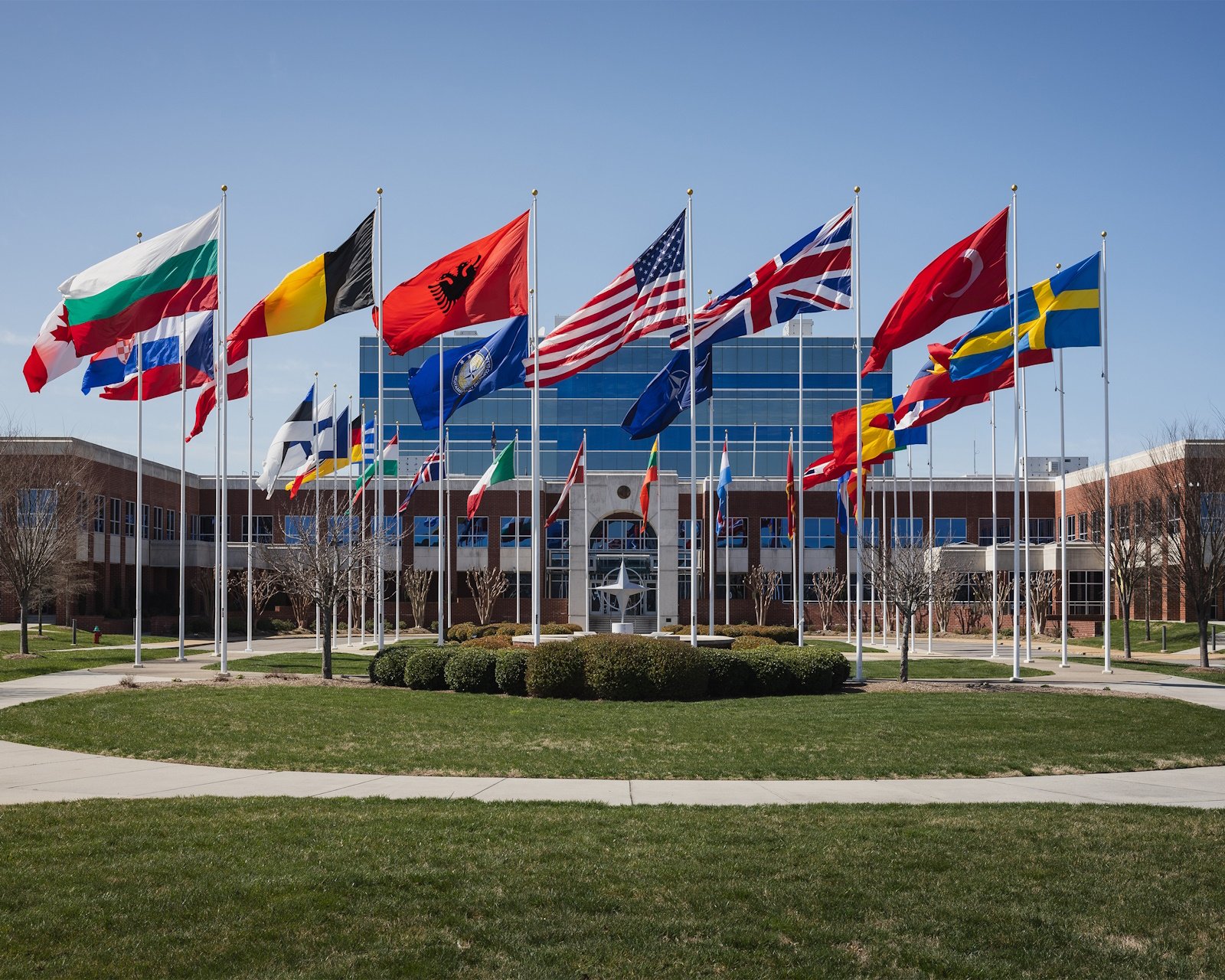
Allied Command Transformation is NATO’s Strategic Warfare Development Command. Its mission is to contribute to preserving the peace, security and territorial integrity of Alliance member states by leading the strategic warfare development of military structures, forces, capabilities and doctrines.
From its inception in 2003, Allied Command Transformation has demonstrated the importance of transformation and development as continuous drivers for change – change that will ensure the relevance of the Alliance in a rapidly evolving and complex global security environment.
Allied Command Transformation is organized around four principal functions:
- Strategic Thinking;
- Development of Capabilities;
- Education, Training and Exercises; and
- Cooperation and Engagement.
Allied Command Operations is NATO’s Strategic Warfighting Command. It is responsible for the planning and execution of all NATO military operations. Allied Command Operations’ mission is to contribute to Alliance defence and security by maintaining the integrity of Alliance territory, safeguarding freedom of the seas and economic lifelines, and to preserve or restore the security of its members.
Allied Command Transformation and Allied Command Operations complement each other in shaping the current and future operating environment, equipping the warfighter to face any security challenge in support of NATO’s principles and interests.
Allied Command Transformation was preceded by Allied Command Atlantic, established in 1952 under the command of Supreme Allied Commander Atlantic. For 51 years, Allied Command Atlantic’s purpose was to guard the sea lines of communication between North America and Europe, to allow for reinforcement of North American troops and supplies to European Alliance members in the event of a Soviet/Warsaw Pact invasion of Western Europe.
A Post-9/11 NATO Command Structure
After the terrorist attacks on 9/11, NATO leaders recognized the need for a new military command structure to meet the challenges of the 21st century. The Alliance agreed to reorganize its command structure and establish Allied Command Transformation.
The 2002 Prague Summit Declaration reaffirmed the need for a “leaner, more efficient, effective and deployable” command structure to meet the operational requirements of NATO missions. The new command structure was adopted the following year, with the inauguration of Allied Command Transformation occurring on June 19th, 2003.
With the creation of Allied Command Transformation and its counterpart, Allied Command Operations, the logic underpinning the Alliance’s command structure shifted from one based on geography to one based on function.
Allied Command Transformation would act as a forward-looking command focused on fostering change, developing future capabilities required by the Alliance and improving interoperability. Allied Command Operations would become the command responsible for all Alliance operations, including the maritime operations previously undertaken by Allied Command Atlantic.
The declaration from the Prague Summit states:
The strategic command for Transformation, headquartered in the United States, and with a presence in Europe, will be responsible for the continuing transformation of military capabilities and for the promotion of interoperability of Alliance forces, in cooperation with the Allied Command Operations as appropriate.
In 2023, Allied Command Transformation celebrated its 20th anniversary.
ACT’s Contributions to the Alliance
In a complex and rapidly changing international security environment, Allied Command Transformation’s aim is to enable NATO forces to be strong and agile, ready and mobile, and interoperable. Specifically, Allied Command Transformation:
- Ensures maximum interoperability of Alliance members and Partners including through the biggest interoperability event of its kind in NATO, the Coalition Warrior Interoperability Exercise – or CWIX;
- Develops concepts that describe new ways of dealing with emerging challenges;
- Identifies opportunities and constraints in the adoption of new technologies through experimentation and analysis;
- Leverages a vast network of military and civilian expertise in member and partner countries, industry, academia, Joint Commands, NATO agencies and NATO-accredited Centres of Excellence to promote the exchange of ideas;
- Contributes to the NATO Defence Planning Process, leading the transformation of political guidance into capability commitments by all NATO members;
- Defines individual training standards and ensures connectivity of equipment and security protocols, including driving Federated Mission Networking;
- Defines and manages new programmes to modernize NATO’s capabilities;
- Educates and trains thousands of military and civilian personnel each year, delivering large- and small-scale exercises and pre-deployment training;
- Supports Allied Command Operations, enabling Allied warfighters to maintain a decisive edge.
By allowing Forces to understand better and decide faster, Allied Command Transformation ensures the Alliance’s warfighters are able to deter, defend and fight – today and tomorrow.
For the next 20 years and beyond, Allied Command Transformation will work closely with Allied Command Operations to provide the collective defence of one billion people, guided by the NATO Warfighting Capstone Concept (NWCC).
This is NATO’s Military North Star, its organizing principle for warfare development in NATO and across the Alliance. The NWCC is the first concept of its kind, offering an agreed upon 20-year vision for NATO military adaptation.
The NWCC describes the future environment in terms of increasingly boundless, simultaneous and persistent challenges. The NWCC’s design for the future Military Instrument of Power is adversary-centric and risk and opportunity-based to out-think, out-excel, out-fight, out-pace, out-partner and out-last any adversary or threat.
Within the NWCC, there are also five Warfare Development Imperatives:
- Influence and Power Projection: To enable the ability to conduct operations by further improving the Alliance’s understanding of how conflicts emerge, as well as harnessing outreach and connection with non-NATO entities and partners.
- Layered Resilience: To maintain the ability to operate whilst being contested and/or under attack, in all domains, both militarily and in civil society.
- Cognitive Superiority: To enable global understanding of adversaries, potential adversaries and ourselves.
- Integrated Multi-Domain Defence: To protect the ability to conduct operations simultaneously in all domains.
- Cross-Domain Command: To enable a near-instant, clear, cross-domain understanding of any situation to facilitate synchronized decision making.
Data and Innovation
ACT will guide the Alliance so it can become a data-centric, multi-domain military power through data exploitation, digital transformation, experimentation, audacious wargaming and modelling and simulation. ACT is also implementing innovative solutions for military use.
Data Exploitation
Data, often described as the oil of the 21st century, fuels the engine of advanced analytics, data science and artificial intelligence. ACT will work to achieve information superiority and data-driven decision-making at all levels across the Alliance.
In 2022, Defence Ministers endorsed the Data Exploitation Framework Strategic Plan, which lays out the effort to improve data management and data literacy for years to come.
Digital Transformation
Competition from adversaries and the continuing technological revolution necessitate the need for the Alliance to develop new ways to understand better, decide quicker and execute stronger.
By 2030, ACT will guide NATO Digital Transformation to enable the Alliance to conduct Multi-Domain Operations, ensure interoperability across all domains, enhance situational awareness and facilitate political consultation and data-driven decision-making.
Experimentation
Experimentation is a powerful tool that supports the transformation of the Alliance. Exploring, examining and objectively validating solutions will help maintain NATO’s military edge.
Experimentation continuously evolves to serve Alliance Warfare Development at the pace of disruptive technologies and future warfighters’ needs. Experiments can be delivered through Wargaming, Modelling and Simulation and other Warfare Development enablers. They may be set up as standalone activities or integrated in exercises or current operations.
ACT sponsors around 20 experiments each year, collaborating with other NATO commands and agencies, member countries, NATO-accredited Centres of Excellence and industry and research Institutes. The Concept Development and Experimentation Conference serves as a venue for promoting experimentation in the Alliance.
Audacious Wargaming
Audacious Wargaming reinforces NATO’s competitive edge today and into the future with an ethos of creation, discovery and exploitation of opportunities. Audacious Wargaming provides a venue for practising decision-making, exploring risk and evaluating options for actions to support NATO’s Deterrence and Defence.
The Audacious Wargaming Capability will become more comprehensive in the coming years, with the goal of developing a formalized program of work and fully exploiting the capabilities of its wargaming network.
Modelling & Simulation
Modelling and Simulation, in combination with technologies such as Data Analytics and Artificial Intelligence, help NATO to prepare and support decision-makers and staff to manage complexity and evaluate options in the multifaceted security environment.
Modelling and Simulation provides risk-free experimentation, education and training by the exploration of alternatives and dynamic visualization of political, military, economic, social, information and infrastructure environments.
Innovation
Innovation drives military adaptation, generating and collecting ideas that can be turned into capabilities through Warfare Development.
ACT’s Innovation Hub, in partnership with Old Dominion University and the NATO Innovation Network, hosts experts to collaborate and design solutions to meet NATO’s challenges.
NATO’s Think-Tank for Information Decision & Execution Sprint, or TIDE Sprint, is ACT’s premier event for promoting innovation and developing concepts and specifications to improve systems interoperability. TIDE Sprint addresses interoperability from a people-process-technology perspective by encouraging attendees – operators, engineers, scientists and academics – to share and exchange ideas and contribute to current and future solutions.
New Reality
The Alliance must stand ready to preserve cohesion and unity, resolve and resilience in the face of multifaceted challenges: all while remaining fit for conducting its three core tasks in the degraded future security environment.
To meet those many challenges, the first step is to “understand better.” For Allied Command Transformation this includes climate change and Cognitive Warfare.
Climate Change
Climate change is one of the defining challenges of our time. NATO is determined to become a leading international organization in understanding and adapting to the impact of climate change on security. Climate change is a threat multiplier that will transcend Allied security in the Euro-Atlantic area. Extreme temperatures, rapid changes in precipitation patterns and an increasing frequency and intensity of weather events will test the resilience of military installations and critical infrastructure.
NATO will increase awareness, learn how to adapt its capabilities to the changing climate and mitigate the impacts of climate change through the reduction of greenhouse gas emissions from military activity.
Cognitive Warfare
Current and potential adversaries use Cognitive Warfare to influence the behaviours and beliefs of individuals, groups and populations in order to fracture Western societies. Cognitive Warfare leverages hyper-connectivity, the pervasiveness of data, psychological warfare and cognitive sciences to affect what and how people think and act.
Future wars will be ever more connected. Speed and information overload, combined with deliberate cognitive attacks to disrupt decision-making, will increasingly challenge the cognitive functions of our forces.
Allied Command Transformation: Understand Better, Decide Faster, Stronger Together
Allied Command Transformation studies the global security environment and develops warfighting concepts, capabilities, training and exercises. The Command also contributes to defence planning and otherwise maintains and develops the Alliance’s warfighting advantage.
Allied Command Transformation works to improve the readiness and credibility of NATO’s posture and helps the NATO Command Structure to efficiently command, control and support current and future military operations.