From filling the application form, to successfully conducting the video interview, mastering the written exercise and finally make a good impression during the panel interview, this page will help you navigate the complexities of the NATO talent acquisition process.
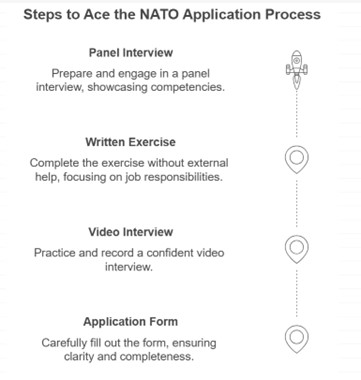
Steps to Ace the NATO Application Process
These steps will help you prepare for your interview, and make the most out of your time.
- Read the vacancy notice carefully.
- You can save the application form as a draft and edit it as many times as you wish before submitting it.
- Do not wait until the final moment to press the submit button, in case there are technical issues.
- If you try to edit or submit the form after the deadline, the changes will be rejected by the online recruitment system.
- NATO will only evaluate the information you write in the text boxes on the application form, so make sure you provide clear answers and mention the most important information. Do not write “please see my CV.” Applications with “see CV” or similar will be automatically rejected
- You may upload documents to support your application form (such as your CV), but they will not be formally evaluated.
- Use bullet points or paragraphs to structure your answers and make them easier to read.
- Prepare your answers to the pre-screening questions in a separate document to easily check for spelling or grammar mistakes and ensure your answers respect the character limits.
- Choose a good place to record the interview. Ideally in a quiet and well-lit room, free from distractions.
- Test your computer’s camera and microphone to make sure they are working properly.
- Try the practice questions on the online platform before you do the real interview. This will help you get used to talking to the camera and answering questions within time limits. You can attempt the practice questions as many times as you wish.
- Look at the camera when recording your answers. If you find this difficult, place a photo or an object behind your computer screen in line with the camera, so you have something to make eye contact with.
- Re-read the vacancy notice and look carefully at the job description. The questions in the written exercise will be in line with the responsibilities mentioned in the job description.
- Organise your time effectively. Read through the exercise first, to see how many questions there are and how the marks are distributed.
- Do not use ChatGPT, similar tools or any other forms of outside help during the written exercise. If the use of outside help is detected, you will be disqualified.
- Re-read the vacancy notice carefully. Make sure you are familiar with the job description and the requirements.
- Read up on NATO, the division and recent events or topics that might be relevant.
- The interview questions are designed based on the requirements and competencies listed in the vacancy notice. Be prepared to give recent examples of how you demonstrated these..
- Project yourself in the role. Be prepared to talk about your motivation, your approach to certain tasks and why your professional experience makes you a good fit for the role.
- Listen carefully to the questions and take a few seconds to organise your thoughts, perhaps jotting down a few bullets points before answering. Ask for clarification if the question is not entirely clear to you.
- Prepare one or two relevant questions for the hiring manager to find out more about the position and its context, or NATO in general.
- Be yourself and act naturally.