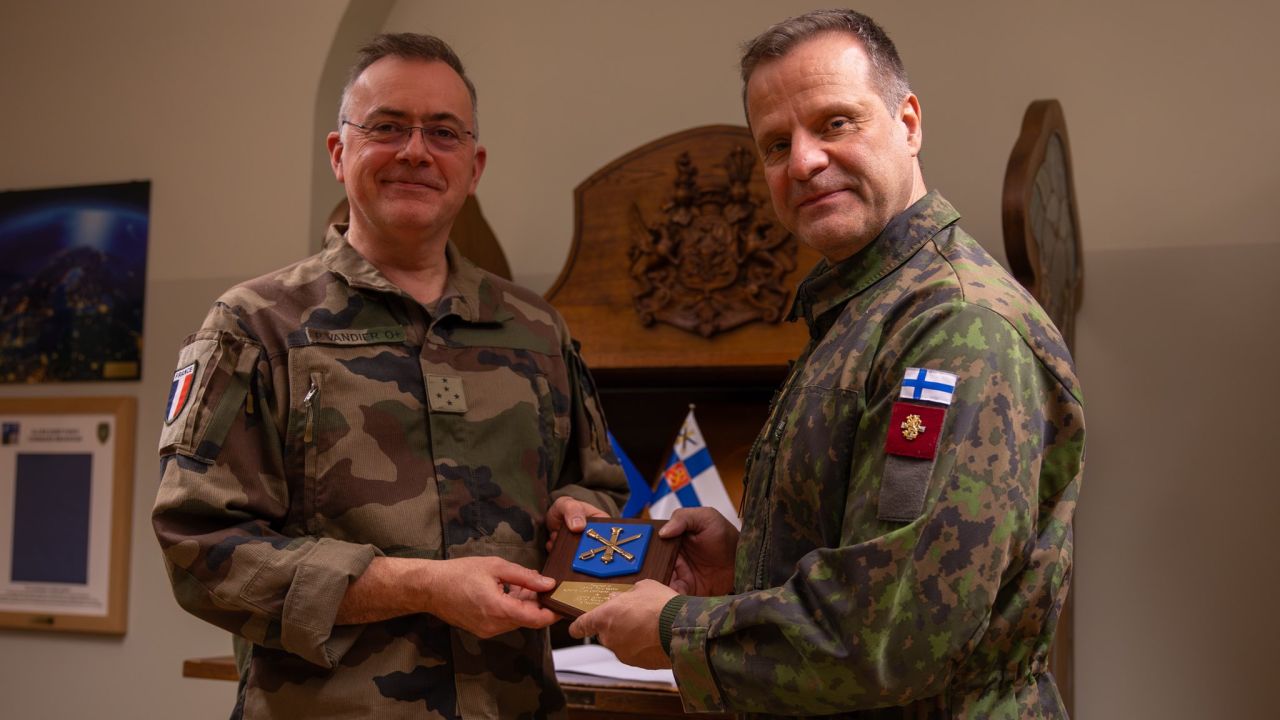
Supreme Allied Commander Transformation, Admiral Pierre Vandier, visited Finland last week as part of NATO’s ongoing effort to accelerate adaptation and strengthen the Alliance’s readiness for future conflict. Hosted by the Commander of the Finnish Defence Forces, General Janne Jaakkola, the visit focused on technology, innovation, and Finland’s long-standing approach to total defence.
Allied Command Transformation (ACT) leads NATO’s strategic military development, helping the Alliance adapt faster than potential adversaries. For Admiral Vandier, Finland offered a practical example of how military capability, industry, and society can be integrated to meet modern security challenges.
Total defence as a foundation for Multi-Domain Operations
During his visit, Admiral Vandier highlighted Finland’s experience with total defence as particularly relevant in today’s security environment. The concept, which integrates military preparedness with broader societal resilience, aligns closely with NATO’s evolving approach to Multi-Domain Operations.
Finland demonstrates key characteristics of modern defence: societal resilience, fast innovation, and the effective integration of emerging technologies.
Admiral Pierre Vandier,
Supreme Allied Commander Transformation
Modern conflict, he noted, is no longer confined to a single domain or to purely military actors. Success increasingly depends on the ability to orchestrate effects across land, maritime, air, cyber, space, and the civilian environment. Finland’s long-standing emphasis on national resilience and public defence provides valuable lessons for the Alliance as it adapts to this reality.
Industry, innovation, and speed of adoption
A key element of the visit was engagement with Finnish industry. Admiral Vandier met with companies working across communications, space, and artificial intelligence, including Nokia and ICEYE. These engagements underscored the growing importance of close cooperation between armed forces and industry partners.
General Jaakkola emphasized that speed of development is now a decisive factor in defence.
“It is important that we stay abreast of this development, from both a national defence perspective and that of deterrence and collective defence,” General Jaakkola said. “Rapid development is possible through close cooperation between the defence administration and businesses.”
Admiral Vandier echoed this view, noting that technological advantage today depends less on long development cycles and more on speed of adoption. Lessons from the war against Ukraine have shown that the ability to adapt systems, software, and tactics rapidly can be decisive. In contrast to traditional procurement models measured in decades, modern systems may evolve in months or even days.
This shift requires a new way of working with industry. Capabilities must be developed closer to the user, tested through experimentation, and adapted continuously based on operational feedback. According to Admiral Vandier, this approach is becoming essential for maintaining military relevance.
Emerging domains and Alliance advantage
The visit also highlighted the increasing convergence of military and commercial technologies, particularly in space and communications. Advances in commercial space capabilities now have immediate military relevance, from imagery and communications to electronic warfare support. Small, scalable systems can generate significant operational effects, offering new options for resilience and redundancy.
Admiral Vandier noted that secure communications technologies, including 5G, contribute not only to military effectiveness but also to broader strategic autonomy and societal resilience. These developments reinforce the importance of innovation ecosystems that support both national defence and collective security.
Deterrence on NATO’s Eastern flank
Against the backdrop of a deteriorating security environment, Admiral Vandier underscored NATO’s clear assessment of Russia as a long-term threat. Deterrence, he stressed, depends on convincing any potential adversary that aggression would not succeed.
For nations on NATO’s Eastern flank, this means sustained investment, credible readiness, and the ability to endure over time. Even small shortfalls in stockpiles or preparedness can have significant consequences. Reconstituting stocks and sustaining forces are therefore fundamental requirements, alongside longer-term adaptation.
From lessons identified to operational change
Admiral Vandier repeatedly returned to one central challenge: speed. While NATO possesses advanced technology and sufficient resources, the real test lies in integrating new capabilities into doctrine, training, and operational practice. Bureaucratic processes and complex procurement systems can slow adaptation at precisely the moment when speed is most critical.
To address this, ACT is placing increasing emphasis on large-scale experimentation, accelerated training, and the rapid integration of lessons learned from ongoing conflicts. Accepting a degree of risk, simplification, and incremental improvement is necessary to move faster and remain credible.
Finland as an example within the Alliance
In his engagements in Finland, Admiral Vandier described the country’s approach as a strong example within NATO. Finland’s defence planning is aligned with NATO Defence Planning Process requirements, and its emphasis on total defence offers a compelling model for resilience and deterrence in a contested security environment.
As NATO continues to adapt to fast-changing threats, visits such as this reinforce the importance of learning from national experience, strengthening industry partnerships, and accelerating transformation across the Alliance.