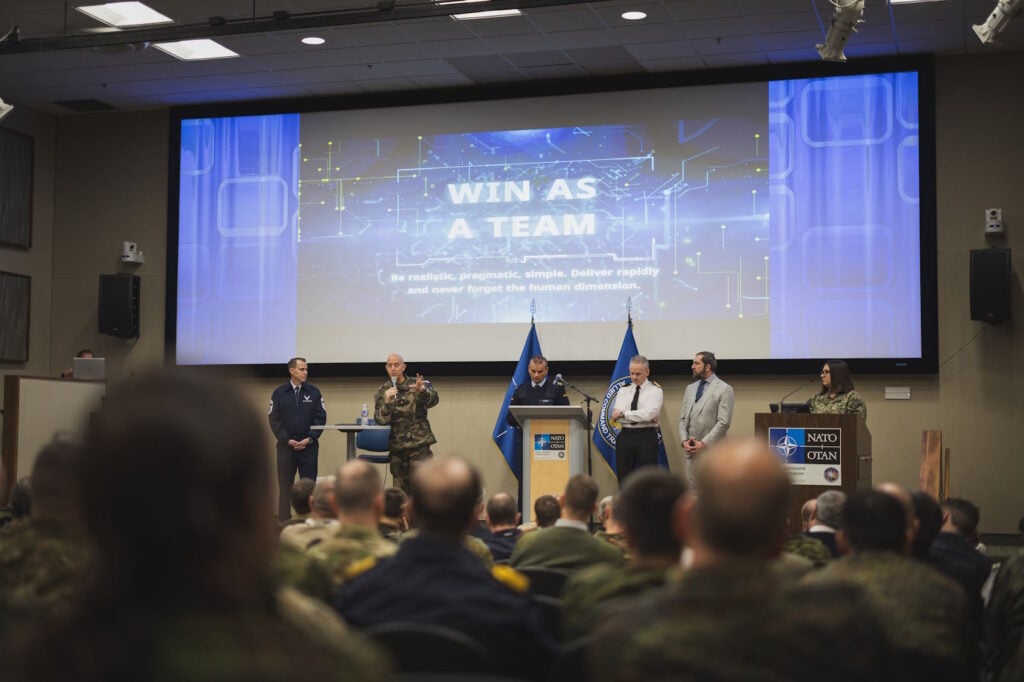

General Philippe Lavigne, Supreme Allied Commander Transformation, recently outlined his priorities for 2024 to over 1,000 civilian and military personnel across NATO. The mission of NATO’s Strategic Warfare Command is to enhance interoperability and military effectiveness through strategic transformation and warfare development. General Lavigne hammered the point home: Allied Command Transformation’s work is not just about tomorrow, it fuels the Alliance’s edge, today, tonight, and into the future.
The Command leads NATO’s warfighting transformation, collaborating closely with Allied Command Operations and entities within and outside NATO. The unique responsibilities of Allied Command Transformation extend to partnerships with institutions, industry, academia, and think tanks, further reinforcing NATO’s posture, capabilities, and policy.
The Command transforms the Alliance through strategic thinking, defence planning, innovation, wargaming and experimentation, capability and interoperability development. Defence planning, in particular, promotes harmonization and synchronization among Allies, fostering fair burden-sharing. Allied Command Transformation develops common-funded capabilities, standards, interoperability solutions, and education, serving as the cohesive agent across national capabilities.
As 2024 marks the second year of the war, Allied Command Transformation remains committed to supporting Ukraine’s fight for freedom. Allied Command Transformation stands with Ukraine in its hour of need, providing critical training and fostering capability development. This year will also mark NATO’s 75th anniversary and a momentous NATO Summit in Washington D.C., a pivotal event where the Alliance will chart its course for the future. In the lead-up to this summit, Allied Command Transformation will continue to be a driving force, aligning its efforts with the Secretary General’s Priorities and Milestones and collaborating closely with Allied Command Operations to move the Alliance ever closer to the Multi-Domain Operations-enabled Alliance NATO needs. This unwavering commitment ensures that the freedom and security the Alliance cherishes remain protected, not just today, but for generations to come.
General Lavigne opened his remarks by underscoring the enduring significance of Allied Command Transformation staff’s endeavours. “Our actions today forge not just the future, but the very shield that safeguards the Alliance’s advantage, today, tonight and in the dawning light of tomorrow.”
This clarion call to action translates directly into Allied Command Transformation’s unwavering mission:
- Today, building seamless interoperability, uniting forces into a single, invincible unit. Imagine a battlefield where allied forces move as one, their capabilities seamlessly integrated into a singular instrument of might. This is the vision that drives Allied Command Transformation’s relentless pursuit of interoperability, forging an ironclad unity that stands as the first line of defence against any threat.
- Today and tomorrow, enhancing operational effectiveness, honing the edge for every challenge. The battlefield is constantly evolving, demanding ever-sharper skills and strategies. Allied Command Transformation is meeting this challenge head-on, relentlessly refining operational effectiveness through cutting-edge training, exercises, and wargaming. This ensures that the Alliance’s forces remain at the highest level of combat prowess, ready to overcome any obstacle that may arise.
- And for the Alliance’s shared future, leading the warfighting NATO transformation, forging a coherent instrument of Power to win tomorrow.
He stressed the importance of adapting to change while taking account of existing processes. Some of the work related to interoperability includes implementing a digital strategy, with a particular focus on data-centricity through the development of an Alliance Cloud environment; accelerating operationalization of cyber and space; continued efforts on deterrence strategies, Command and Control and Cross-Domain Command concepts; and the simplification of experimentation processes for rapid scalability. The recent Allied Command Transformation – Latvian Ministry of Defence Next Generation Communications Network – technology event demonstrated the potential benefits of collaboration with industry and academia.
In discussing his second mission, enhancing operational effectiveness, General Lavigne pointed to the complexity that 2024 will bring, emphasizing the need for a realistic, pragmatic, and simple approach, with a focus on delivering rapid results. He cited advancements in cognitive warfare to address the influx of misinformation and disinformation, using Artificial Intelligence-based decision support tools, and engaging in research and development projects that can then be experimented during NATO exercises.
The third and ultimate mission is to lead the transformation of NATO’s Military Instrument of Power in order to protect NATO’s shared future. Identifying what tomorrow might look like, through the Future Operating Environment and Future Force Studies, which will be completed in 2024, will assess the capabilities NATO needs to counter adversaries who are also constantly evolving. Allied Command Transformation will deliver the final Minimum Capability Requirement and the draft Capability Targets, the former representing the agreed-upon list of necessary military capabilities, while the latter outlines specific goals related to those capabilities.
General Lavigne declared “My priority for 2024 is working on the fast and massive transformation of the Military Instrument of Power towards a Multi-Domain Operations enabled Alliance”.
In pursuit of this critical objective, Allied Command Transformation will deliver key deliverables for the Alliance, Nations and Partners:
- Cognitive Superiority: Emphasizing decisive and informed decision-making, the command aims to deliver the Cognitive Warfare Concept and advance data and AI implementation;
- Layered Resilience: Improving NATO’s overall deterrence, focusing on Cyber Space Resilience Concept, and addressing vulnerabilities in military and civilian layers;
- Influence and Power Projection: Enhancing the ability to deter and synchronize all Instruments of Power, including key capabilities in Command & Control, Electronic Warfare, Cyber, and Joint Targeting;
- Cross Domain Command: Delivering the Cross Domain Command Concept, directing the largest Coalition Warrior Interoperability Exercise, and advancing AI assistance in common-funded capabilities;
- Integrated Multi-Domain Defence: Developing an Alliance Multi-Domain Defence Framework Concept, releasing the Specification Roadmap for Federated Mission Network, and focusing on tactical Multi-Domain Operations capabilities.
Supporting these efforts are cross-cutting initiatives like strategic foresight, NATO Defence Planning Process, Digital Transformation, and Enhanced Capability Development. General Lavigne also stressed the importance of societal and environmental considerations, integrating gender perspective, climate change, and human security across all activities.
His priorities underscore the urgency of adapting to a rapidly changing security landscape, emphasizing innovation, collaboration, adaptability and interoperability. As NATO evolves, the commitment to common values, collective defence, crisis management and cooperative security remains an integral part of the Alliance.