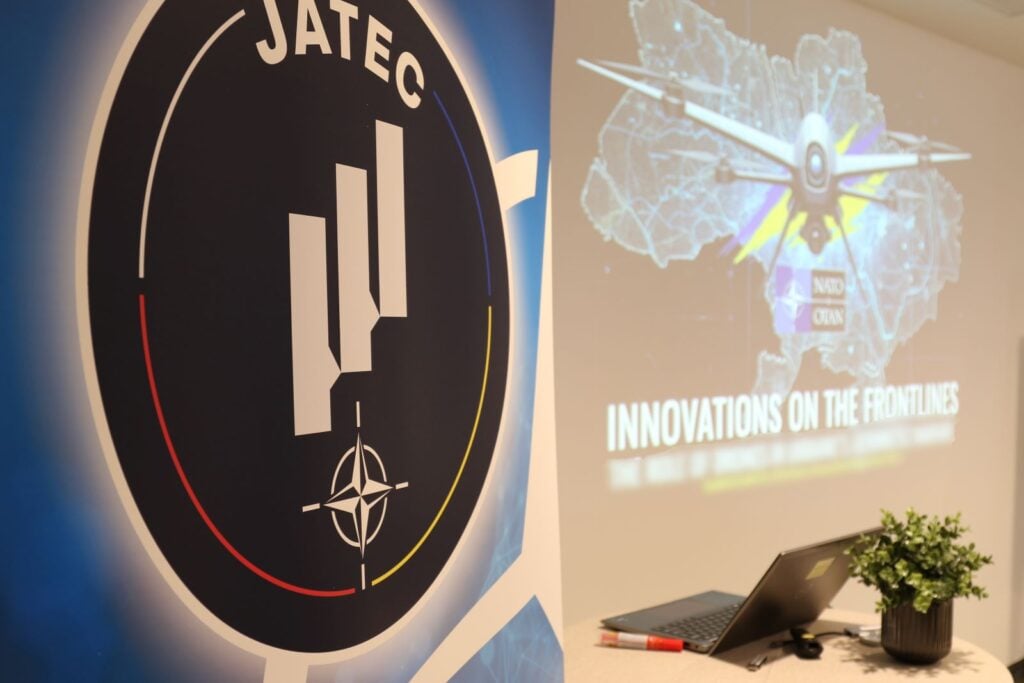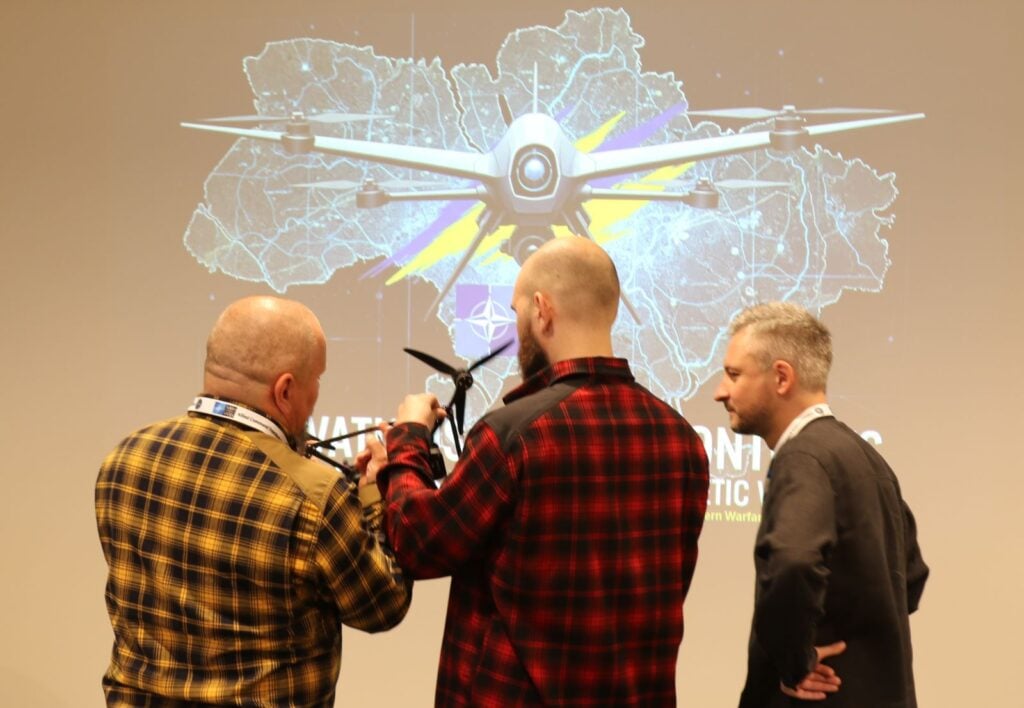

Last week NATO Allied Command Transformation, in partnership with the NATO-Ukraine Joint Analysis Training and Education Centre (JATEC) and with support from the NATO Cooperative Cyber Defence Centre of Excellence, concluded the 16th NATO Innovation Challenge. Two companies from the United States, and one from Ukraine, took the top prizes in this iteration of the event which focused on a pressing and highly specific operational problem seen in Ukraine: detecting, tracking, and neutralizing fibre-optic-controlled First-Person View (FPV) drones. This is an emerging class of unmanned threats which have rapidly reshaped the tactical battlefield. The three winners will have the opportunity to test their solutions with the assistance of NATO Allied Command Transformation.
Since its inception in 2017, the NATO Innovation Challenge has served as a vital link between the Alliance and the global innovation community. By design, the Challenge attracts non-traditional problem-solvers like academia, individuals, startups, and accelerates the integration of creative solutions into the NATO ecosystem. Each iteration identifies a discrete, often fast-emerging threat, then invites international participants to propose cost-effective, scalable responses. Winning teams receive direct exposure to NATO stakeholders and are positioned for further prototyping, field testing, and potential operational adoption.
At the event, Admiral Pierre Vandier, NATO’s Supreme Allied Commander Transformation said stressed that “we need a dynamic mindset… we need to test fast and to sometimes fail fast because we will also learn from the failures. That is why the Innovation Challenge is so important.” His remarks underscored NATO’s broader push to accelerate adaptation in concepts and doctrine, but also in the technologies fielded to confront emerging threats.
- An Urgent and Evolving Threat
This 16th edition of the Innovation Challenge addressed a threat that has only recently entered operational use: fibre-optic-controlled First-Person View drones. First documented in Russian deployments in late 2024, these drones maintain control through physical tethering via fibre-optic cable. This allows them to circumvent traditional electronic warfare defences, which rely on disrupting radio frequency communication.
As a result, standard counter-unmanned aircraft systems, many of which depend on jamming or signal spoofing, have proven ineffective against these systems. The drones’ small radar and visual signature, combined with high manoeuvrability and direct pilot control, make them particularly dangerous in frontline and urban environments. They are capable of top-attack manoeuvres, evasive flight profiles, and precise targeting, often at low cost.
“There is no better way to innovate than to apply real combat experience. The solutions that are being developed within this Innovation Challenge are military-shaped and aim to save lives,” emphasized Brigadier General Wojciech Ozga, commander of NATO-Ukraine Joint Analysis Training and Education Centre, one of the NATO entities coordinating this 16th iteration of the NATO Innovation Challenge.
To counter this threat, NATO solicited proposals across three mission phases:
- Detection and prioritization using radar, thermal, acoustic, or optical sensors
- Guidance and tracking capable of calculating speed, distance, and flight trajectory
- Neutralization, whether kinetic or non-kinetic, in a modular, deployable package
Solutions needed to meet several demanding criteria, including sub-100kg total weight, day-and-night operation in adverse weather, 500-meter detection range, and a cost-effective design suitable for near-term deployment in Ukraine.
- Diverse Finalists, Common Ground
This year’s NATO Innovation Challenge set a record with 162 technical proposals submitted, including 42 from Ukrainian teams, a testament to the strength of Ukraine’s engineering community and military technical sector despite the ongoing full-scale war. “The participation of Ukrainian companies in NATO innovation hackathons is critically important to accelerate the development of miltech, as it allows our technical requirements to synchronize with Alliance standards. Through the JATEC platform, we are not only integrating combat experience into scalable solutions but also ensuring compatibility of tools for achieving battlefield domination,” said Deputy Minister of Defence of Ukraine Valery Churkin.
From this competitive field, nine finalists were selected to present their solutions to a panel of NATO experts and operational stakeholders. Their proposals spanned a wide spectrum of concepts, from compact kinetic interceptors to software-defined radar systems and autonomous turrets, yet common themes emerged in their emphasis on modularity, cost-effectiveness, and rapid deployability.
- Kinetic Defeat Remains the Baseline
Most solutions focused on physically destroying the drone through high-speed, close-range engagements. Among these, several novel approaches stood out. One proposed a five-barrel rotary shotgun system designed for short-range saturation fire, capable of 3,000 rounds per minute and equipped with a unique high-capacity magazine. Another innovator submitted a specially designed 12-gauge projectile connected by a Kevlar tether, optimized for drone engagements at 100–120 meters and already proven in combat scenarios.
Autonomous turrets, often AI-assisted, formed the backbone of many kinetic systems. These units were designed to mount on vehicles or tripods, offering wide elevation and azimuth ranges, thermal optics, automatic tracking, and seamless integration with external sensor feeds.
- Radar Renaissance: Making Detection Affordable
A key differentiator this year was a renewed focus on radar-based detection, especially for small drones in adverse conditions. Several finalists pushed the boundaries of cost and capability. One team proposed a software-defined radar capable of generating 3D point cloud maps, with AI-based classification and detection of multiple targets. Another introduced a modular radar “block” system that could be configured for either fixed defences or rifle-mount micro-radars, potentially offering man-portable drone detection for the first time.
These systems prioritized open data standards, ensuring interoperability with NATO systems. Nearly all entries offered real-time sensor fusion between radar, optical, and thermal streams, allowing for more precise and earlier threat recognition.
- AI, Autonomy, and Operator Safety
Across the board, artificial intelligence played a critical role in target classification, trajectory prediction, and fire control. Rather than removing the human entirely from the loop, most systems offered a range of modes, from fully manual to AI-assisted to semi-autonomous engagement, supporting varied operational rules of engagement.
Some teams integrated passive acoustic detection or signal tracking to complement visual sensors. Others layered in additional safety features, including automated “human presence detection” to prevent friendly fire incidents. Several systems also offered remote weapon station compatibility and durable control interfaces for use on moving vehicles.
- Speed, Modularity, and Production Readiness
In line with NATO’s rapid deployment timeline, nearly every solution emphasized manufacturability and field integration. Most platforms were designed around commercial off-the-shelf components, and many leveraged existing manufacturing partnerships or venture-backed production pipelines. Several finalists claimed the ability to field operational prototypes within six months.
Modularity was another consistent theme. Participants offered multi-loadout systems, with options for kinetic and non-kinetic payloads (such as nets or electro-magnetic spectrum pulses), interchangeable sensor suites, and plug-and-play integration with existing NATO or Ukrainian command and control systems.
- Winners and Way Ahead
After final presentations, NATO’s judging panel assessed submissions based on five core criteria: technical feasibility and innovation, operational relevance to Ukraine, scalability and integration potential, cost-benefit balance, and modularity.
The top three finishers in the June 2025 Innovation Challenge were:
- First Place: KMB Telematics, Inc. (USA)
KMB delivered a modular radar solution that enables cost-effective detection and tracking of small, low-signature aerial threats. Their software-defined system, built from commercial components, supports rapid deployment and integration across multiple NATO platforms, offering scalable detection capacity at significantly reduced cost.
- Second Place: Sentradel (USA)
Sentradel’s autonomous turret system integrates sensor fusion and AI-driven fire control to deliver precise kinetic and non-kinetic responses to First-Person View drone threats. Its modular platform, adaptable payloads, and seamless NATO integration make it a field-ready solution for contested environments.
- Third Place: DONS (Ukraine)
The Ukrainian team proposed a stabilized Remote Weapon Station optimized for First-Person View drone defeat. Featuring AI-driven detection, thermal tracking, and real-time ballistic calculation, the lightweight system offers reliable protection for mobile units and critical infrastructure alike.
These winners demonstrated a rare combination of creativity, technical maturity, and battlefield practicality. Each provided a viable pathway toward rapid fielding and meaningful tactical impact.
- A Growing Innovation Ecosystem
The 16th NATO Innovation Challenge highlighted more than just a technological contest, it reaffirmed NATO’s commitment to building a culture of experimentation and rapid adaptation. As warfare evolves and threats become more asymmetric, the ability to source ideas from outside the traditional defence sector becomes increasingly vital.
With this edition, Allied Command Transformation and its partners continued to expand NATO’s innovation network, deepening ties with emerging technology firms, research institutions, and cross-national development teams. Whether or not individual systems reach the battlefield, the shared learning, operational context, and partnership building will have enduring value.
As NATO looks toward future challenges, the Innovation Challenge remains a powerful tool to scout disruptive ideas, accelerate promising technologies, and equip the Alliance for the battlefields of tomorrow, today.