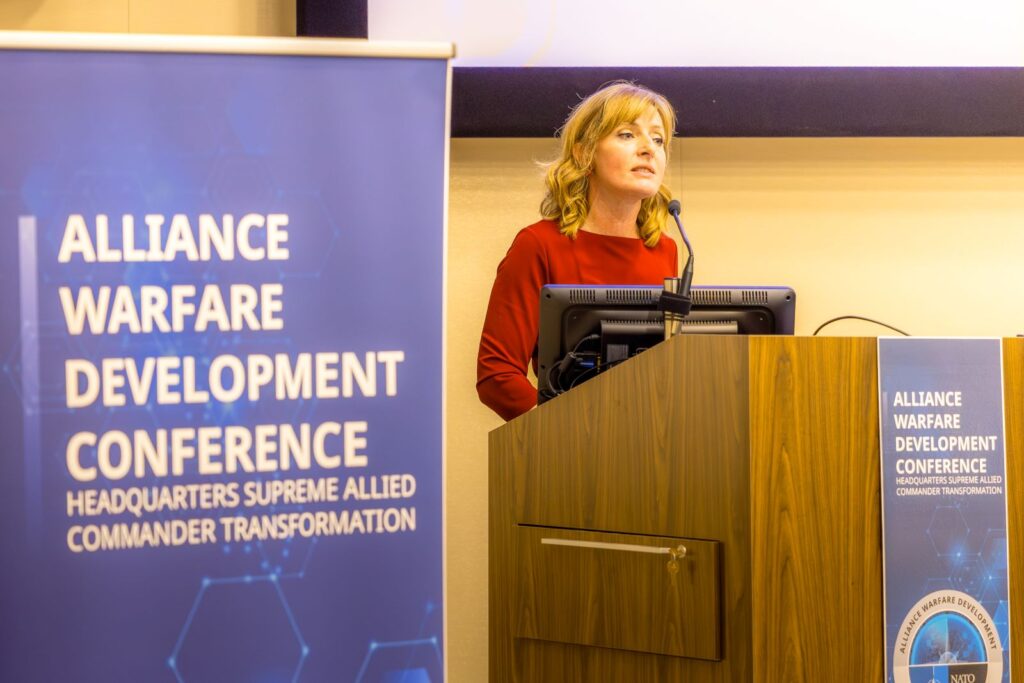

NORFOLK, Virginia. Senior defence leaders, national capability directors and decision-makers from NATO countries gathered in Norfolk this week for the 2025 Alliance Warfare Development Conference. This annual forum focuses on how NATO can prepare its forces at a pace that matches rapid changes in technology and geopolitics. The conference recognized that the strategic environment no longer tolerates slow cycles of analysis and delivery. Modern challenges move too quickly, and the Alliance continues to work hard to match that momentum and remain effective.
A Strategic Environment Shaped by Time
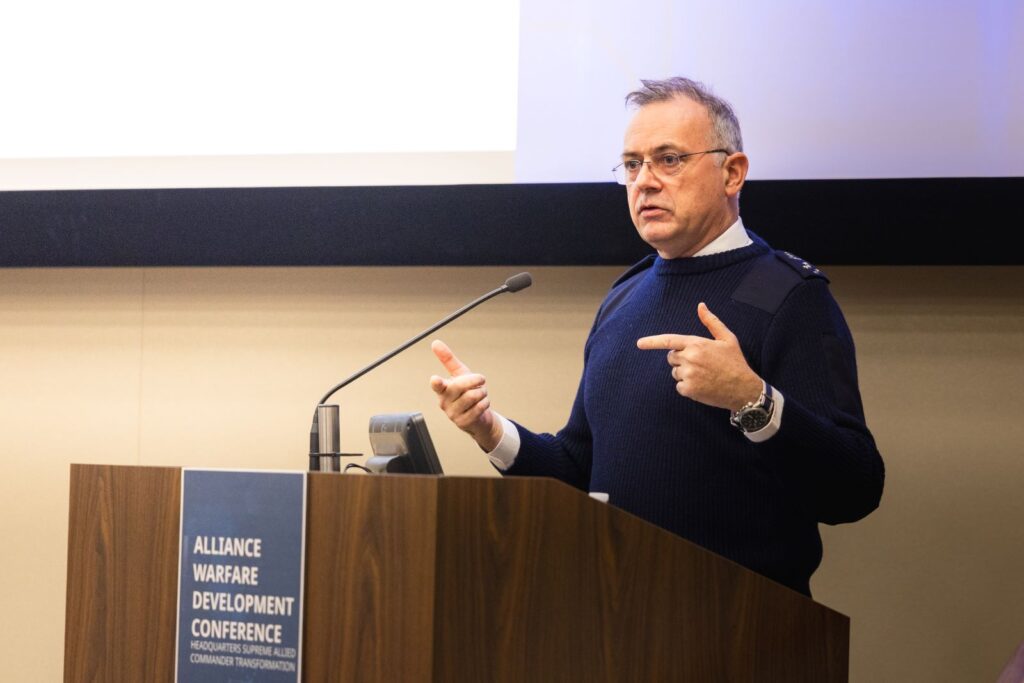
Time is no longer a background consideration in defence planning, it is a core strategic factor. Advances in technology and shifts in global competition are reshaping operational realities far faster than legacy development pathways can respond. Admiral Pierre Vandier, NATO’s Supreme Allied Commander Transformation who hosted the event, challenged attendees to rethink planning processes, urging them to start with the outcomes nations genuinely need and build backward toward the fastest viable route.
NATO should be about results, not about process; working from idea to implementation. Working not for process but for the warfighter.
– Admiral Pierre Vandier
Supreme Allied Commander Transformation
This view of time as a decisive resource resonated throughout rest of the conference: speed is fundamental to maintaining advantage.
Admiral Vandier expanded on this point in his keynote address by framing NATO’s challenge through several critical “loops” that must accelerate in parallel, including the “OODA” (Observe, Orient, Decide and Act) loop, the procurement loop, the “ITAA” (Invent, Test, Adopt and Adapt) loop, and NATO’s broader decision and coordination loops. Each of these shapes how fast the Alliance can observe, decide, deliver, and integrate new capabilities. The message was clear: operational advantage depends on compressing these loops, not treating speed as an isolated concept.
Adaptation as a Core Behaviour
An equally important insight from the conference was that speed alone is not enough. The strategic environment is in constant upheaval like the rapid operational and tactical changes seen in the war against Ukraine. Forces must adopt a mindset that treats adaptation as routine, not exceptional. In a world where assumptions shift quickly, readiness cannot be viewed as something achieved once and set aside. It must be renewed continuously.
Admiral Vandier also emphasized that adversaries are adapting quickly. Russia has become a force that absorbs and applies battlefield lessons quickly, sharing real-time insights with partners. This reinforces the need for the Alliance to out-learn and out-adapt opponents, not just out-pace them.
This perspective pushes back against complacency. Even thorough preparation can be overtaken by unexpected realities, which means long-term advantage depends on the ability to reassess and adjust without hesitation. The Alliance strengthens its deterrence by cultivating habits of continuous movement: projecting forward, updating assumptions, and preparing to pivot as conditions evolve. Adaptation becomes most effective when it is woven into the daily behaviour of organizations, rather than reserved for moments of crisis.
Turning Agility Into a Working Practice
Building on this mindset, the conference explored what agility looks like in practical terms. Innovation often emerges from the willingness to reconsider familiar approaches rather than from new tools alone. Success depends on the ability to recognize when conditions have changed and adjust immediately.
This understanding framed agility as a habit of constant recalibration. Forces must remain ready to shift methods the moment conditions shift around them.
Much of today’s innovation originates in the civilian technology sector, especially in fields like AI and advanced sensing. Strengthening the bridge between civilian industry and military development was presented as essential to sustaining NATO’s qualitative edge.
Making Capability Development Move Faster
Leaders in the sessions discussed how capability development can keep pace with this environment. Several ongoing efforts at Allied Command Transformation demonstrate how development can accelerate when treated as an iterative process. Work within the Task Force X series and the SINBAD initiative showed how early increments can deliver operational value while still allowing rapid refinement. This has proven that momentum is created through repeated, fast-paced gains rather than a single major output.
These developments also highlighted structural challenges. Delivering software quickly requires approval lines and funding mechanisms capable of supporting frequent updates. Systems designed for slow, linear development can unintentionally create friction. The conference approached these issues with a clear message: accelerating delivery requires aligning structures and expectations so that speed becomes the norm, not the exception.
Procurement processes must evolve to match the pace of operational need. High-end platforms will remain vital, but accelerating complementary capabilities, such as rapidly fielded autonomous systems, can close near-term gaps while larger programmes mature.
Preparing a Force That Evolves Continuously
The conversations about delivery naturally connected to the broader ambition of shaping a future-ready force. Findings from Allied Command Transformation’s Future Force Study and the Force Lethality Enhancement effort reinforced the idea that modernization must remain dynamic. Adversaries adapt quickly, technology evolves rapidly, and global conditions shift without warning. Forces must therefore evolve continuously, not episodically.
This long-term vision is linked to accelerating NATO’s own internal decision and development cycles. Modern operations depend on data as the fuel of the battlefield and the Alliance must strengthen Command and Control modernization and data-sharing practices if it is to integrate new capabilities at speed.
This view aligned with wider discussions across the Alliance, including efforts to increase defence production and strengthen industrial cooperation. Greater output only matters if new capabilities reach the field at operational pace, reinforcing the value of agile delivery and rapid integration.
Resilience in a Disrupted World
Resilience emerged as another essential element of readiness. Nations are refining their contributions to the developing Layered Resilience concept, focusing on how to maintain operational effectiveness despite disruptions that may span multiple domains. Recent wargaming insights highlighted pressures that forces may confront and revealed where resilience must deepen.
Additional insights from the NATO-Ukraine Joint Analysis and Training and Education Centre underscored that resilience is both structural and human. Infrastructure and planning matter, but so do adaptability, cognitive agility, and training designed to prepare personnel for uncertainty.
Experimentation as a Source of Advantage
Experimentation provided another channel for strengthening adaptability. Initiatives being pursued through Allied Command Transformation’s Beacon Projects demonstrated how testing ideas in demanding settings can reveal promising approaches earlier and help refine them more quickly. These efforts reinforced a principle repeated throughout the conference: experimentation only creates advantage when its insights flow directly into development pipelines, shaping decisions in real time.
Experimentation gives nations early, practical choices by revealing what works and what does not. Through rapid testing and evidence-based assessments, Allied Command Transformation can then offer a range of viable solutions that reduce development timelines.
The Takeaway
By the end of the conference, a clear direction emerged. The Alliance must act at the pace the environment demands and cultivate the mental agility to adapt just as quickly. These two principles, speed as a strategic requirement and adaptation as a daily behaviour, form the foundation of modern warfare development. The 2025 Alliance Warfare Development Conference reinforced that Allied Command Transformation will continue to guide this effort, ensuring that NATO remains ready to think, decide, and deliver with the momentum needed for a rapidly changing world.