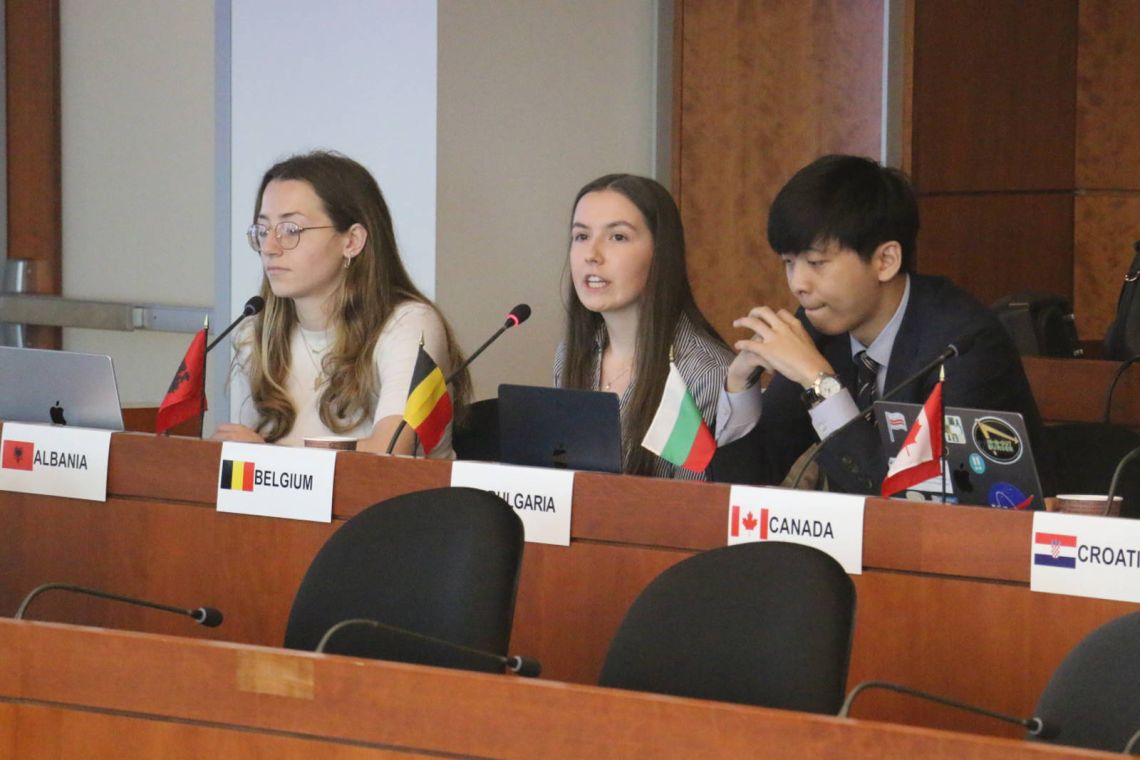
WASHINGTON, DC – On April 5th, 2023, NATO’s Allied Command Transformation ran a NATO Model Event at The George Washington University Elliot School of International Affairs. Students simulated a North Atlantic Council session and discussed whether NATO should adopt a High North policy.
For this year’s NATO Model Event, select students from The George Washington University were tasked to represent a NATO member state and Sweden. They had to research their country’s High North policies and negotiate positions with their fellow students, to arrive at a consensus on whether NATO should adopt an Allied policy for the High North. The event required students to demonstrate their critical thinking, research skills, public speaking ability, and adaptability.
Allied Command Transformation staff ran the event, providing students insights on the importance of open debate and consensus-driven decision-making within the North Atlantic Council. By the end of the event, the students had agreed – and disagreed – on a series of political and military measures relating to the High North. Allied Command Transformation officials, who acted as the Secretary General, Chair of the Military Committee and Assistant Secretary General, chaired the North Atlantic Council. The NATO Model Event was another opportunity for Allied Command Transformation, headquartered in Norfolk, Virginia, to continue its work in youth engagement and academic outreach, and promote the mission and values of NATO.
For many students, this NATO Model Event was their first experience with NATO’s decision-making process. The student representing Estonia shared thoughts after the event: “It was interesting to see real policy discussions play out between 31 nations and the different views you have to take into account. You have to make compromises even while everything is shifting.” The shifting environment was tangible for the representative of Finland, who was able to participate as a full NATO member, as the NATO Model Event took place one day after official Finnish accession to the Alliance.
For other students, the event clarified the importance as well as the difficulty of understanding and appreciating the views of others. The representative for the United Kingdom discussed the impact of collaborative approaches: “Original ideas are broken down through the structure of the discussion, so there’s an importance to precision and building coalitions over a breadth of perspectives and issues.”
After the event, students asked NATO representatives a series of questions about how NATO operates, the Alliance’s future, and how to get involved with NATO. Dr. Alyssa Ayres, Dean of the Elliott School of International Affairs, noted that the NATO Model Event occurred at a time of growing complexity in international affairs, and in particular: “[…] the challenges of reaching consensus in a multinational environment.” She also highlighted the impact of academic relationships for international alliances like NATO – The George Washington University is one of the primary academic partners of NATO’s Allied Command Transformation.