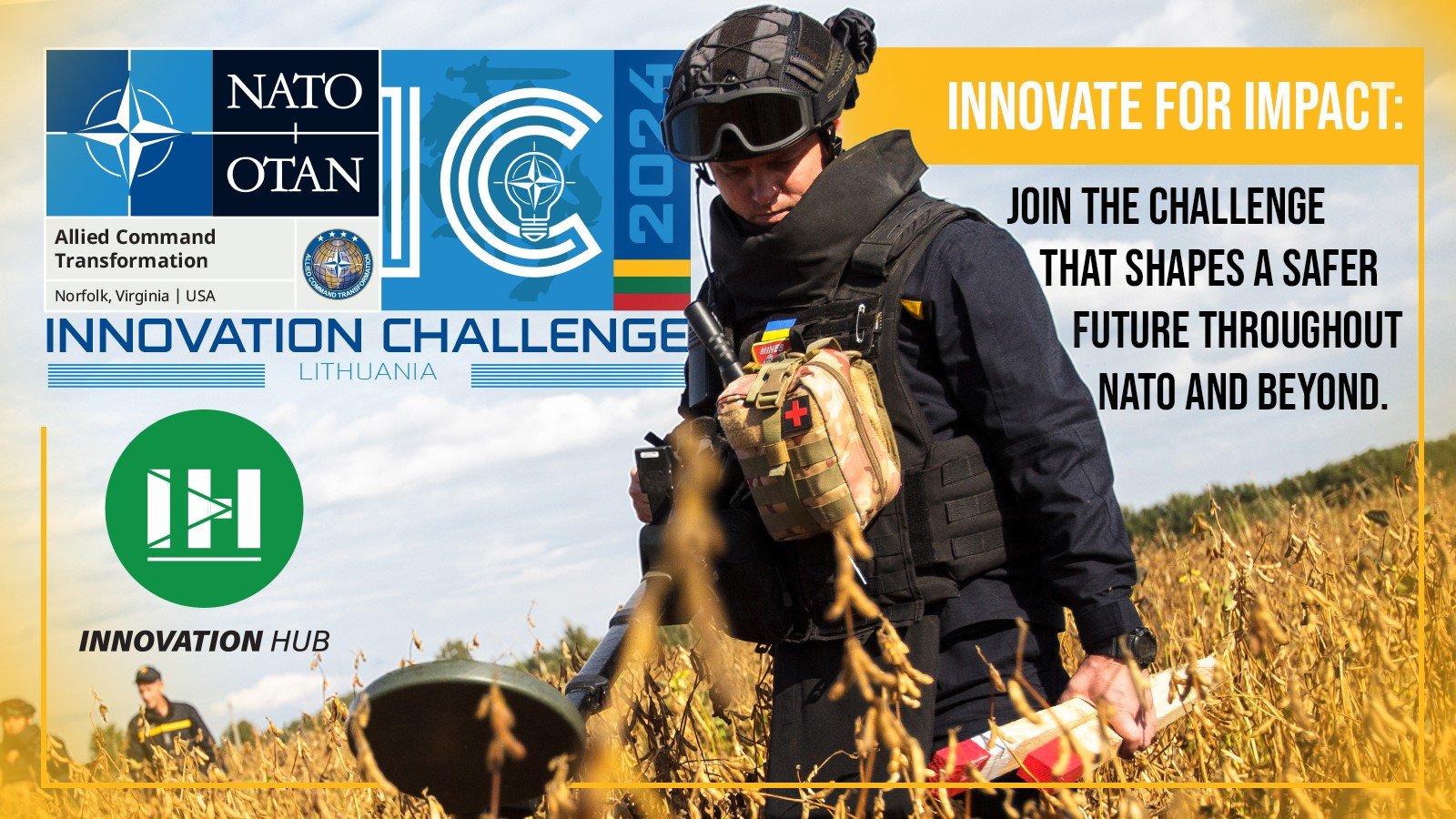
The NATO Innovation Challenge stands as a beacon for cutting-edge solutions aimed at addressing some of the most pressing global security issues. This year’s challenge, focused on Remote Explosive-Contaminated Area Recognition and Neutralization, drew 51 entries from thirteen countries, each proposing innovative approaches to the complex task of mine clearance. Among the notable entries was the innovative solution from Srinath Mallikarjunan and his team at UAB Unmanned Dynamics. As the second-place winner, Mallikarjunan’s work exemplifies how aerospace technology can be effectively adapted to address critical humanitarian challenges, such as demining, by leveraging advanced AI, sensor fusion, and drone technology for safer and more efficient operations.
As the founder of this deep tech company based in Vilnius, Lithuania, Mallikarjunan’s career has been a journey of transforming aerospace engineering into impactful humanitarian solutions. His recent recognition as the second-place winner in the NATO Innovation Challenge highlights his commitment to developing advanced drone technology for mine clearance.
A Journey of Innovation
Mallikarjunan’s career began at the University of Illinois Urbana-Champaign, where he graduated with a strong foundation in aerospace engineering. Over a decade, he honed his expertise in designing helicopters, aircraft, and multirotors. At UAB Unmanned Dynamics, Mallikarjunan and his team focus on developing cutting-edge drone technologies. Their latest creation, a parallel hybrid cargo drone, is a testament to their innovative prowess, designed to carry over 50 kg for distances exceeding 50 km.
This drone, initially conceived for military applications like clearing artillery sectors, has found an innovative role in demining operations. The company’s demining solution, propelled by the visionary leadership of Liauda Miseviciute, their head of business development, is a result of years of meticulous development in offensive weapons technology.
Motivations and Challenges
Mallikarjunan’s motivation to participate in the NATO Innovation Challenge was driven by a desire to leverage their expertise in swarm navigation, artificial intelligence, and multi-sensor fusion. The humanitarian impact of mine clearance and the complex technical challenges it presents were compelling reasons for their involvement. “The challenge of demining is particularly compelling due to its significant humanitarian impact and the technical complexities involved,” said Mallikarjunan.
The Technology Behind the Solution
UAB Unmanned Dynamics’ approach to mine clearance integrates multiple advanced technologies. The solution employs drone swarms equipped with a variety of sensors, which fly in a grid pattern to map out mined areas. The data from these sensors is stitched together in real-time on the edge, creating comprehensive mosaics of the operational area. This data is then analyzed using artificial intelligence algorithms to detect mines.
One of the innovative aspects of their technology is the use of a software-defined radar by the drone swarms, which generates a low-cost synthetic aperture radar. This approach is essential for detecting mines of various types and depths. Once mines are detected, antitank mines are neutralized by a Turtlebot Unmanned Ground Vehicle, while anti-personnel mines are dealt with using a modified road roller Unmanned Ground Vehicle. Mallikarjunan explained that their “goal has been to eliminate the need for humans to risk their lives in this complicated task and share real time updates using our C3 network with all demining teams.”
Addressing Key Challenges
Mallikarjunan’s solution addresses critical challenges in mine clearance, including speed, efficiency, and safety. The hybrid vertical take-off and landing drones, which can fly for 4-5 hours on gasoline, cover larger areas more rapidly than conventional drones. The integration of advanced artificial intelligence and edge computing facilitates complex sensor fusion and mine identification, adapting to varying soil conditions and depths. By using Unmanned Air Vehicle swarms for comprehensive area mapping and Unmanned Ground Vehicles for neutralization, the system minimizes human risk.
Scalability and Adaptability
Given the extensive mine contamination in conflict zones like Ukraine, scalability is a crucial factor. Mallikarjunan’s solution is designed to be highly scalable, with drone swarms capable of covering large areas efficiently. The hybrid drones’ extended flight times and the use of cloud-based AI for real-time data processing make the system feasible for deployment in vast, heavily mined regions.
The adaptability of their solution extends beyond Ukraine. The system’s flexibility allows it to be tailored to different terrains and types of landmines by adjusting sensor payloads and refining artificial intelligence models. This adaptability is crucial for addressing diverse and evolving mine clearance challenges across various geographical contexts.
Future Innovations and Collaborations
Despite significant progress, several hurdles remain in remote mine clearance. These include the diversity of mine types, environmental conditions, and the need for real-time data processing. Mallikarjunan advised that “future innovations should focus on enhancing sensor technologies, improving artificial intelligence algorithms for better accuracy, and developing more robust edge computing solutions.” Collaboration between NATO, academia, and industry is essential for accelerating these advancements. NATO can offer strategic direction, academia can provide research insights, and industry can drive practical application and scalability.
A Call to Innovators
Mallikarjunan’s message to future innovators and participants in the NATO Innovation Challenge is clear: “focus on practical, scalable solutions that leverage advanced technologies like artificial intelligence, drone swarms, and senor fusion.” He encourages innovators to think about the “human impact of your solutions… Your innovations can save lives and restore safety in conflict zones.” Srinath Mallikarjunan and UAB Unmanned Dynamics embody the spirit of innovation and collaboration essential to addressing global challenges. Their second-place finish in the NATO Innovation Challenge underscores the potential of advanced drone technology in revolutionizing humanitarian demining efforts. As NATO Allied Command Transformation continues to foster a culture of innovation through initiatives like the Innovation Challenge, it is evident that ground-breaking solutions, such as Mallikarjunan’s, are poised to make a significant impact on global security. By supporting and nurturing talent, NATO can accelerate the development of life-saving technologies and create a safer world for future generations.
“Nurturing a deep tech startup is like growing a tree. You plant a seed, and it takes years to develop a solid trunk from which many branches can grow. Software-defined radar and our swarm algorithms are just some of the branches in our tech stack. People often overestimate what can be accomplished in one year and underestimate what can be achieved in ten. My advice to deep tech startups is to stay the course, believe in your ideas, and ignore societal pressures. Of course, this is easier said than done,” concluded Mallikarjunan.