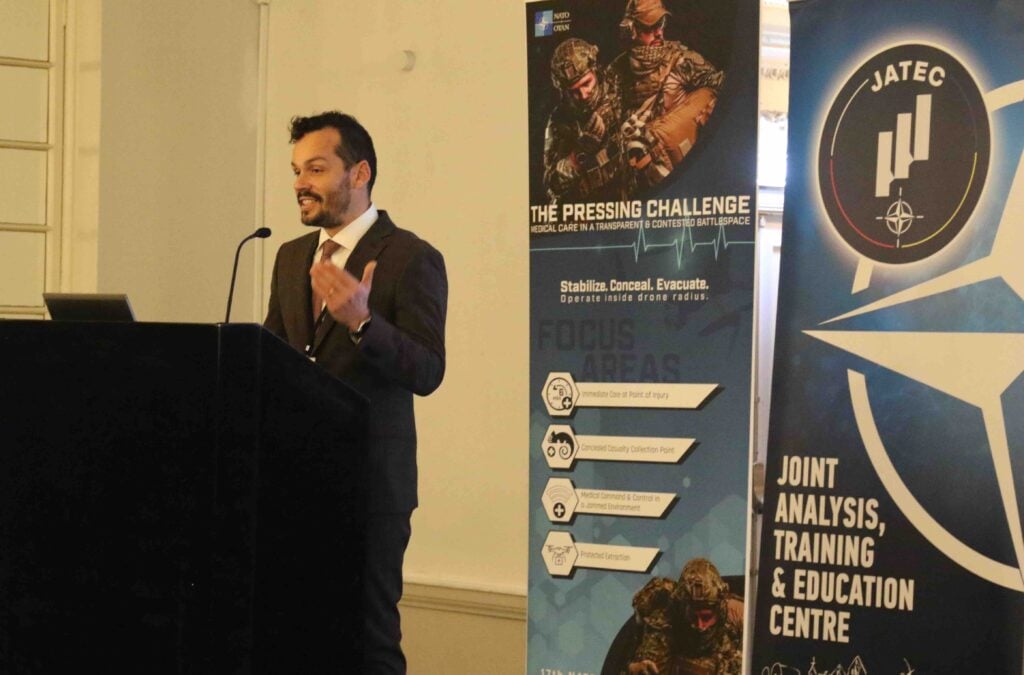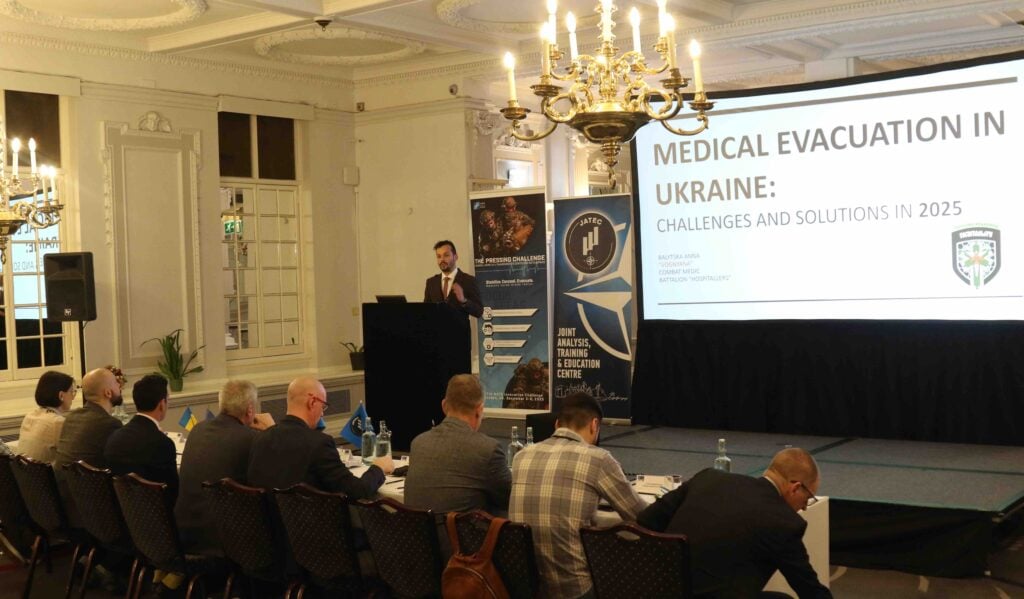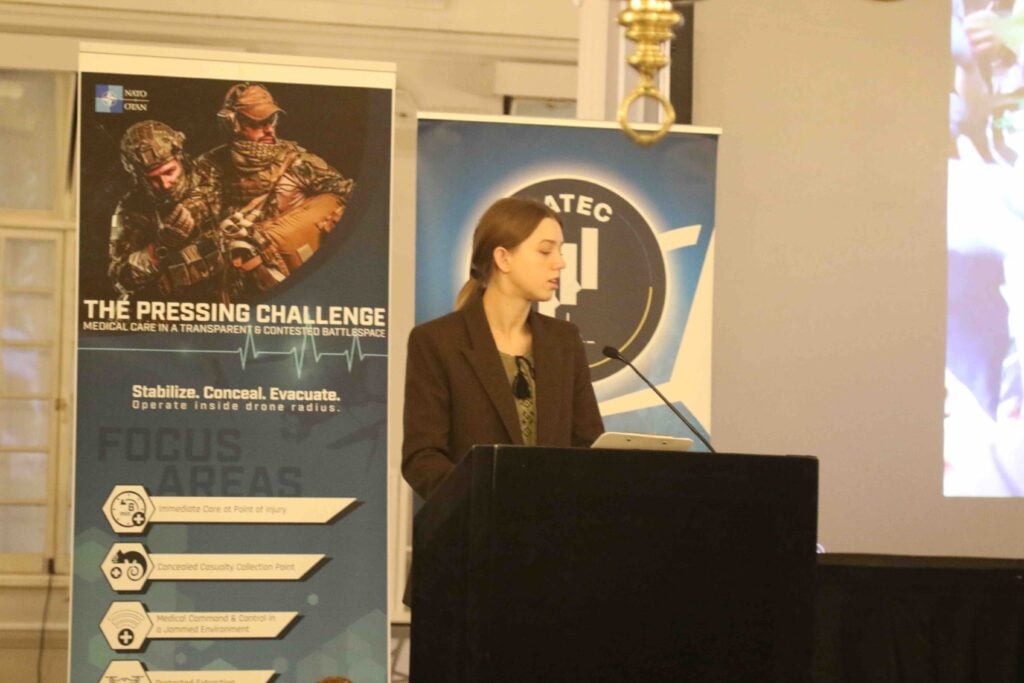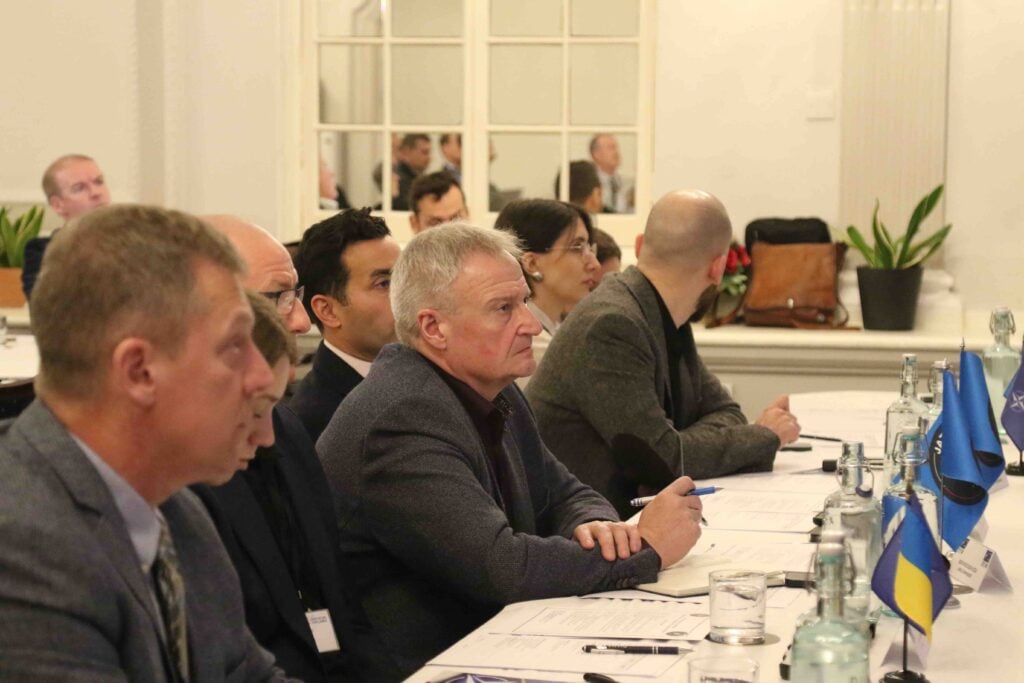

LONDON, United Kingdom. NATO Allied Command Transformation, in partnership with the NATO-Ukraine Joint Analysis, Training and Education Centre (JATEC), concluded the 17th NATO Innovation Challenge today. Three international teams were selected as winners in this edition, which focused on one of the most urgent frontline problems exposed by the war against Ukraine: sustaining life and enabling safe casualty evacuation inside an eight-kilometre drone kill-box where constant surveillance, jamming, and first-person-view attacks make movement dangerous and slow.
The three awardees will now work with Allied Command Transformation to move their solutions toward rapid prototyping and field testing. This year’s Challenge highlighted another core priority for the Alliance: strengthening NATO’s layered resilience. The medical ingenuity presented at the event will help sustain continuity of operations despite persistent threats.
Since its launch in 2017, the NATO Innovation Challenge has brought non-traditional innovators into the Alliance’s problem-solving ecosystem. Each edition defines a sharply focused operational gap and invites industry, startups, academia, and independent developers to propose practical ideas that can be deployed at speed. Winning teams gain direct engagement with NATO stakeholders and a pathway that can lead to experimentation, adaptation, and potential integration with Allied forces.
A New Medical Reality in a Transparent Battlespace
This December’s Challenge addressed the full spectrum of prolonged field care and casualty extraction under relentless aerial observation. In Ukraine, evacuation delays of 60 to 120 minutes have become common as drone coverage and responsive fires turn the “golden hour” for care into a “golden day”, with wounded frequently waiting hours to reach a facility that could perform surgery. This has increased the need for rapid point-of-injury care, low-signature shelters, autonomous extraction tools, and resilient medical command and control.
To meet this reality, NATO solicited solutions in four focus areas:
Immediate Care at the Point of Injury
Technologies that deliver haemorrhage control, analgesia, and life-sustaining interventions in under six minutes.
Concealed Casualty Collection Points
Shelters or decoys that sharply reduce visual, infrared, or radio frequency signatures for up to eight hours of prolonged field care.
Protected Extraction
Unmanned stretchers, pods, or ground vehicles capable of moving injured personnel one to five kilometres under threat of splinters and FPV strikes.
Medical Command and Control (C2) in a Contested Electromagnetic Spectrum (EMS)
Low-probability-of-intercept and low-probability-of-exploitation digital networks for triage, vital-sign telemetry, and medical tasking even when Global Navigation Satellite System (GNSS) and standard radios cannot be trusted.
Proposals needed to meet demanding conditions: operation from minus twenty to plus forty degrees Celsius, compatibility with NATO medical standards, and a path to fielding within twelve months.
Layered Resilience: Medical Readiness as a Critical Pillar
This year’s Challenge also highlighted a growing operational truth. In a battlespace shaped by drones, jamming, and constant sensing, medical capability is inseparable from NATO’s broader approach to layered resilience. Allied Command Transformation describes layered resilience as a system of mutually reinforcing military, civil-military, and societal layers that enable Allies to prepare for, resist, respond to, and recover from shocks while maintaining continuity of operations.
Medical readiness contributes directly to this vision. Rapid point-of-injury interventions preserve the availability of frontline forces. Low-signature shelters and protected extraction solutions improve survivability by reducing exposure to detection and attack. Resilient medical Command and Control protects the flow of critical information even when the electromagnetic spectrum is contested. Together, these advances strengthen the resilience of the Military Instrument of Power by helping forces absorb disruptions, sustain combat power, and fight on in protracted crises.
A Diverse Field with Clear Technical Themes
Finalists represented Canada, Norway, Sweden, the United States, Ukraine, the United Kingdom, and Finland. Their solutions covered every part of the medical chain, but several strong patterns emerged.
Point-of-Injury Technologies Become Lighter, Faster, and More Automated
Several teams addressed the need for extremely rapid stabilization under fire. Concepts ranged from intelligent junctional tourniquets that combine pelvic stabilization with targeted pressure for major bleeding, to compact infusion devices requiring no electricity to deliver critical drugs when medics are under surveillance. One team proposed a portable battlefield renal replacement system, significantly expanding the range of lifesaving interventions possible during extended evacuation delays.
These approaches shared a common emphasis: fast activation, minimal training burden, and designs that avoid creating detectable signatures near the front line.
Concealment and Signature Management Move to the Forefront
Drone transparency has reshaped how medical units must operate. Multiple finalists proposed shelter systems that fold down into backpack form and then expand into ballistic or low-visibility structures for casualty care. These shelters featured materials engineered to reduce infrared glow, limit reflective surfaces, and suppress electromagnetic emissions.
In an environment where a heat plume or metallic edge can trigger a First-Person View (FPV) drone strike, these low-signature shelters represent a major shift from traditional casualty collection points.
Extraction Solutions Emphasize Autonomy and Survivability
The Challenge saw strong interest in unmanned extraction systems. Leading proposals included vacuum-immobilizing stretchers that protect casualties during movement, warming systems to counter hypothermia, and remote-actuated platforms designed to withstand splinters and drone impacts. Some systems combined mechanical stabilization with onboard sensors to monitor patient status throughout the extraction journey.
These concepts aim to remove medics from exposed terrain, reduce engagement risk, and shorten the time needed to reach higher-level care.
Medical C2 Adapts to Jamming and GNSS Denial
A contested electromagnetic spectrum is now the default in modern warfare. Several finalists offered new models for medical command and control that function even when radios cannot. One system used body-confined electric fields to pass triage data and vital signs through touch, enabling medics to establish encrypted networks on the move with almost no emissions. Another entry proposed an offline-first electronic health record designed for frontline use, allowing patient data to move securely through degraded networks without loss.
Across submissions, the common objectives were simple: keep vital information flowing and maintain coordination even under heavy jamming.
Winners and the Way Ahead
NATO’s expert panel evaluated submissions based on operational relevance, technical feasibility, readiness level, cost, and the speed with which solutions could be fielded. Three winners were selected from a competitive field of strong contenders.
First Place: Qidni Labs Inc. (Canada)
A Portable Continuous Renal Replacement Therapy (CRRT) System for Battlefield and Austere Medical Care
Qidni Labs delivered a portable and battery powered battlefield renal replacement system that expands the range of lifesaving interventions possible during prolonged evacuation delays. The system is designed for austere and drone saturated environments where advanced care must begin far forward and under constant threat.
Second Place: MonuMedical LLC (United States)
MiniFuser – A Compact, Simple and Non-Electric Infuser for Critical Medications
MonuMedical’s MiniFuser provides a lightweight, non-electric solution for delivering critical medications at the point of injury. Its simplicity, durability, and mechanical design make it well suited for rapidly changing conditions near the front, where medics must stabilize patients while minimizing exposure.
Third Place: Ixana (United States)
LPI/LPD Medical C2 and Touch to Triage Vital Sign Transfer
Ixana’s system uses body confined electric fields to enable encrypted, low emission transfer of triage information and vital signs. This approach supports medical command and control in heavily jammed environments and helps maintain the flow of critical information when traditional communications are degraded.
These winning concepts combined practicality with creativity, offering feasible pathways toward deployment in Ukraine and across Allied forces. They also reinforced a broader shift underway in military medicine where survivability depends on signature reduction, autonomy, resilience under jamming, and faster interventions at the point of injury.
Strengthening NATO’s Innovation Network
Beyond the individual winning solutions, this edition of the NATO Innovation Challenge demonstrated the value of bringing frontline realities to the global innovation community. Many finalists had direct exposure to Ukrainian combat experience and designed their solutions with clear attention to the constraints medics face under drone surveillance.
Allied Command Transformation and the NATO-Ukraine Joint Analysis Training and Education Centre (JATEC) continue to expand this network, connecting startups, researchers, defence ministries, industry partners, and warfighters. Even when individual prototypes do not progress to fielding, the shared learning and operational insight shape future capability development.
As the battlefield becomes more visible under constant drone surveillance, and more lethal, rapid medical innovation becomes essential. The 17th NATO Innovation Challenge shows how creative, practical ideas from the international community can help save lives, strengthen layered resilience across the Alliance, and support adaptation at the speed demanded by operational necessity.